You are buying an off-plan apartment and the developer informs you that the construction site has reached the “water-tight” stage. Behind this technical term lies a decisive step in your VEFA purchase: it conditions the amount you will unlock, the solidity of your future home, and the delivery schedule. Understanding this milestone means keeping control over your real estate project.
Fund request at the water-tight stage: what VEFA regulations say
Most guides explain the water-tight stage as just a moment in the construction process. In reality, it is primarily a legal and financial threshold governed by the Construction and Housing Code.
Article R.261-14 of the CCH sets legal caps for each fund request in VEFA. The developer can request up to 35% of the price upon completion of the foundations, then 70% at the water-tight stage, and finally 95% upon completion of the building. The remaining balance is only due upon the availability of the housing.
This framework allows for two modes of payment: constant periodic payments or payments proportionate to the progress of the work. In both cases, the above caps can never be exceeded. A developer who requests more than 70% before the roof is installed is acting outside the legal framework.
If you plan to follow the water-tight VEFA with Immo Factory, you will have support to verify that each fund request corresponds to the actual progress of the construction site.
Progress certificate: bank control before unlocking

Why does your bank sometimes delay unlocking the funds requested by the developer? In recent years, banks have tightened their practices. They now require a progress certificate before validating the fund request at 70%.
Specifically, the bank checks that the “water-tight” stage has indeed been reached: roof installed, building protected from rainwater. Without this confirmation, there is no unlocking. This mechanism protects the buyer from a developer who would charge in advance of the actual construction.
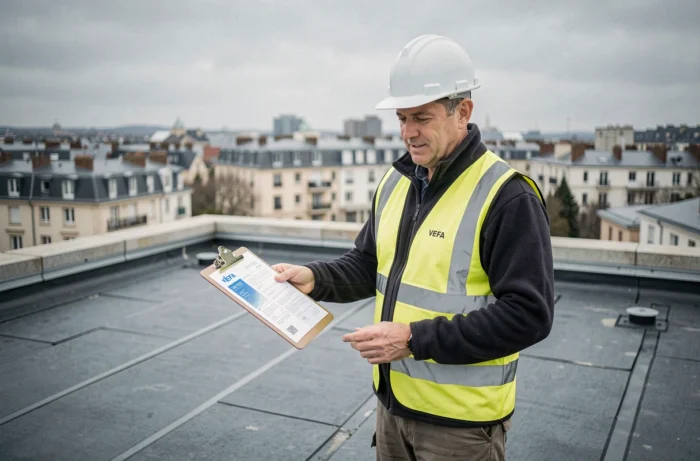
The certificate can come from the project manager, an independent architect, or a control office. You have the right to request to see this document. If your developer refuses to provide it, that is a serious warning sign.
Interim interest during construction
Between the first fund request and delivery, you pay interim interest on the amounts already unlocked. The water-tight stage increases your commitment from 35% to 70% of the price: your interim interest doubles at this stage.
Anticipating this increase in your monthly budget avoids unpleasant surprises. Some buyers negotiate with their bank for a total deferral (capital and interest) until delivery, but this option has a higher overall cost.
Water-tight on the VEFA site: the concrete works
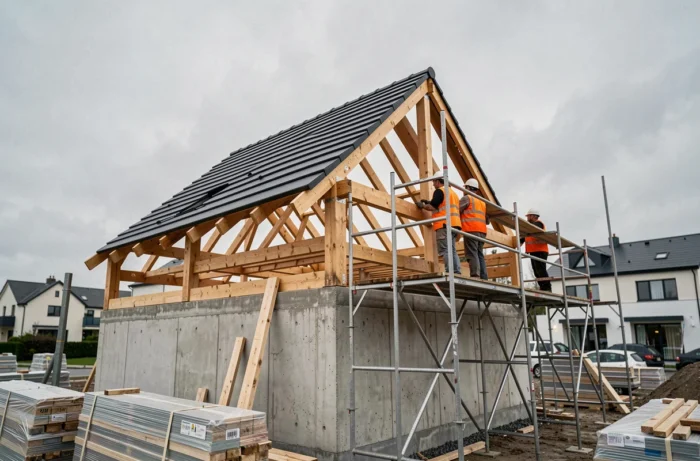
Let’s move from the legal to the concrete. The water-tight stage refers to the moment when the building becomes impermeable to rainwater. This requires three completed physical works:
- The complete elevation of the load-bearing walls and gables, which form the vertical envelope of the building
- The installation of the framework (wood, metal, or concrete depending on the program), which constitutes the load-bearing structure of the roof
- The roofing (tiles, slates, waterproof membrane for terrace roofs), which ensures protection against rain
At this stage, the building has neither windows nor exterior doors. It withstands rain but not wind or cold. This is the difference with the air-tight stage, which occurs after the installation of the exterior joinery.
What remains to be done after the water-tight stage
Once the building is water-tight, the construction site enters the finishing phase. The remaining works still represent a significant part of the project:
- Installation of exterior joinery (windows, doors, shutters) to achieve the air-tight stage
- Installation of technical networks: plumbing, electricity, ventilation, heating
- Thermal and acoustic insulation of walls
- Interior partitions, floor and wall coverings, sanitary equipment
The transition from 70% to 95% of the funds covers all of these works. The last fund request (the remaining 5%) only occurs at delivery, after your acceptance visit.
Check the water-tight stage: points of vigilance for the buyer
You are not obliged to wait for delivery to check the progress. During site visits (which the developer must organize or at least authorize), certain elements deserve your attention.
Observe the roof: the eaves, ridges, and valleys must be complete. A partially covered roof does not constitute a water-tight stage. Also check for the absence of temporary tarps over large areas, which would indicate ongoing work in this area.
Always request the progress certificate before signing the unlocking with your bank. This simple reflex protects you against a premature fund request. In case of doubt about compliance, an independent building expert can accompany you during the visit.
The water-tight stage marks the financial tipping point of your VEFA purchase. It transforms an open construction site into a protected structure and increases your financial commitment to 70% of the total price. Keeping an eye on the progress certificate and verifying the reality of the work on-site remains the best way to secure your acquisition until delivery.