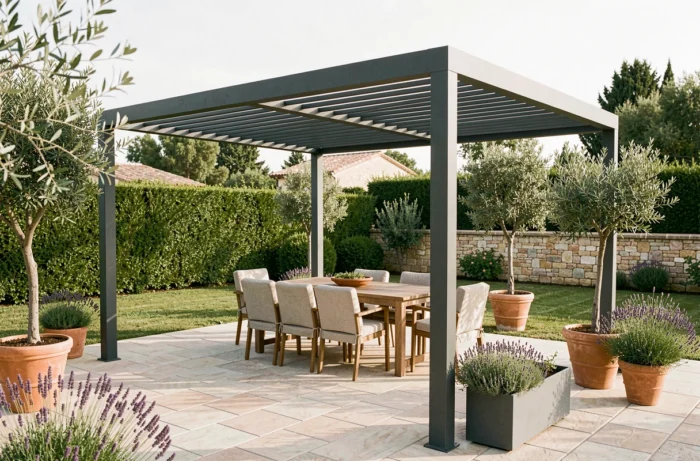
An aluminum pergola 4×3 covers 12 m² of terrace, which is the necessary space to accommodate a table for six to eight people or a comfortable corner lounge. This size dominates residential sales in France, and for good reason: it falls within the most flexible regulatory thresholds while providing enough footprint to create a true outdoor living space.
Aluminum, in this configuration, is not just an aesthetic choice. It is a technical decision that impacts the durability of the structure, its mechanical behavior, and the freedom of layout under the roof.
Structural behavior of aluminum over a span of 4 meters
Over a width of 4 meters, the main beam bears significant bending stresses, especially in the case of climatic loads (snow, standing rain). Extruded aluminum, with an epoxy powder-coated treatment, withstands these forces without permanent deformation, whereas a steel profile of equivalent section would weigh two to three times more and require regular anti-corrosion treatment.
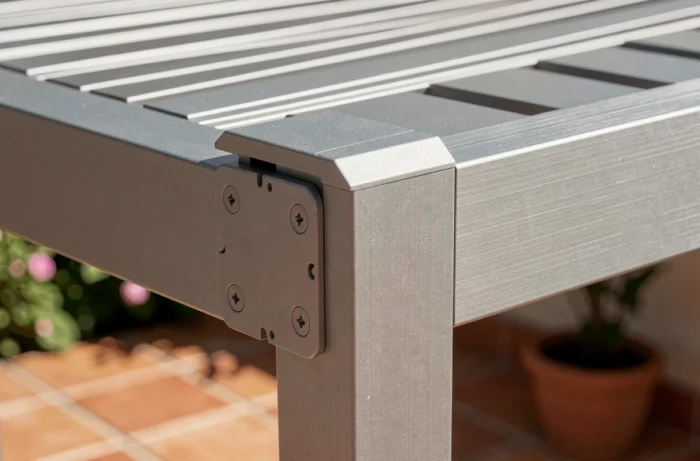
We recommend checking the thickness of the posts when choosing the model. A square or rectangular post with sufficient wall thickness ensures the rigidity of the whole structure, even in a lean-to configuration where only two front posts bear the load. The wall thickness of the posts determines the overall mechanical strength.
The lightness of aluminum also simplifies installation. Two people can handle the elements without lifting equipment, which reduces installation costs and limits the risk of damaging the terrace covering during assembly.
To compare the available models in this format, a 4×3 aluminum pergola at Brico Dépôt provides an idea of the accessible ranges and the features offered at different price levels.
4×3 aluminum pergola and urban planning: thresholds to know before ordering
With its 12 m² footprint, a 4×3 pergola falls below the 20 m² threshold that triggers the requirement for a building permit in areas covered by a local urban plan (PLU). A simple prior declaration of work is sufficient in most cases. In areas not covered by a PLU, the threshold rises to 20 m² instead of 40 m², but the 12 m² remains below.
However, caution is advised: if the total surface area of ancillary constructions (garden shed, carport, pergola) exceeds 20 m² combined on the plot, the situation changes. All enclosed or covered areas must be added together to assess the applicable regime.
- Below 5 m² of footprint: no formalities required, but this area does not apply to the 4×3 format
- Between 5 m² and 20 m² (case of a 4×3 at 12 m²): prior declaration of work at the town hall, processing time of about one month
- Above 20 m²: building permit required, with possible recourse to an architect if the total surface area of the property exceeds a certain threshold
We observe that many homeowners install their pergola without declaration, which exposes them to forced compliance or even demolition if the town hall detects the violation. The risk is not theoretical: aerial photo inspections or neighbor reports regularly trigger procedures.
Adjustable aluminum slats: the adjustment that changes the actual use of the pergola
A 4×3 aluminum pergola with adjustable slats is not just an adjustable roof. The orientation of the slats controls ventilation as much as shading. In a semi-open position, the slats create a Venturi effect that accelerates the airflow under the structure, cooling the space by several degrees without resorting to air conditioning.
In periods of hot wind, a poorly calibrated adjustment causes vibrations and banging, especially at night. The solution is to completely close the slats or orient them in the direction of the prevailing wind to eliminate the differential wind catch between adjacent slats.
Motorization and integrated weather sensors
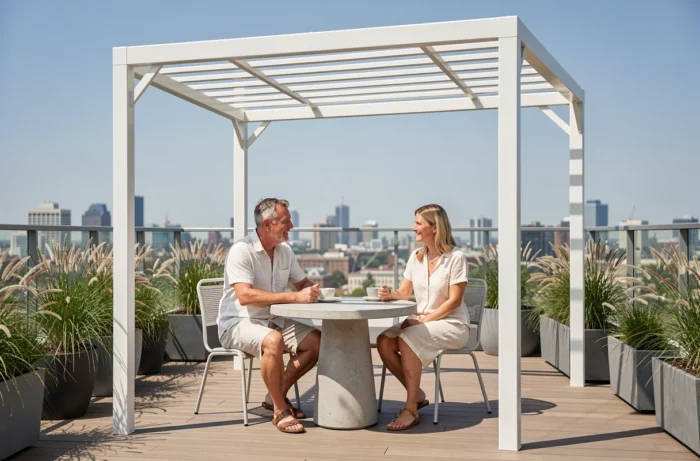
High-end motorized models include a rain sensor and an anemometer. The rain sensor triggers the automatic closure of the slats to protect the furniture. The anemometer, on the other hand, opens the slats beyond a wind threshold to reduce the load on the structure.
An integrated anemometer protects the structure in case of gusts. Without this device, a closed pergola facing strong winds experiences uplifting forces that can tear away wall fixings, especially in a lean-to configuration.
Lean-to or freestanding pergola in 4×3: technical arbitration
The choice between a lean-to pergola and a freestanding model is not solely aesthetic. In a lean-to configuration, the structure transfers part of the loads to the house wall. This requires checking the nature of the support: a solid block wall or concrete can accept fixings without difficulty, but a hollow brick or wood frame wall requires specific chemical anchors.
The choice between lean-to and freestanding depends first on the fixing wall. If the support is not load-bearing or if external insulation creates a gap between the structure and the wall, the freestanding configuration with four posts becomes preferable. It also offers more freedom of placement in the garden, whether in a central island or along the pool edge.
- Lean-to pergola: two front posts, rear wall fixing, reduced footprint, requires an accessible load-bearing wall
- Freestanding pergola: four posts, free positioning, stability independent of the building, foundations or ground plates required
- Semi-lean-to pergola: one wall post and three ground posts, a compromise used when the wall allows only partial fixing
Side screens and LED lighting
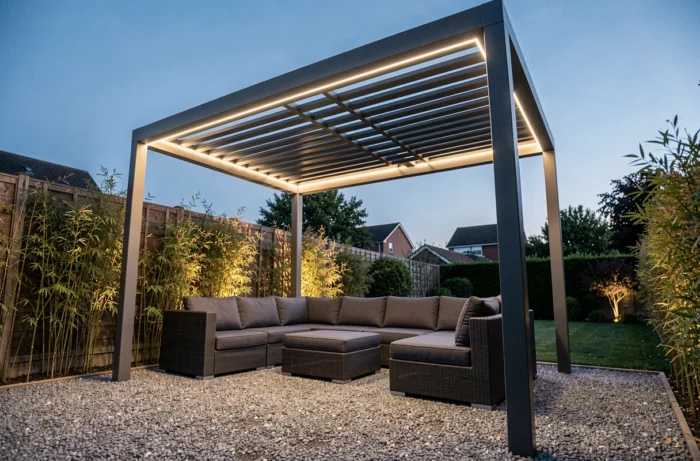
The addition of vertical screens on one or two sides transforms an open pergola into a semi-closed space, usable in side winds or oblique rain. The micro-perforated fabric screens filter light without blocking ventilation. The LED strips integrated into the beams extend evening use without visible additional electrical installation.
These options increase the budget, but they determine the actual frequency of use of the pergola. A structure without side protection or lighting remains unused for a good part of the season, which puts the initial savings into perspective.
The 4×3 aluminum format remains the best balance between usable space, regulatory constraints, and technical feasibility for a residential terrace. The real selection criterion lies in the details: profile thickness, quality of motorization, type of fixing, and options for side closure. These elements, rarely compared in product sheets, make the difference between a pergola that serves ten months a year and a structure that is underutilized.