A used SUV priced at 15,000 euros can cost double in three years if the mechanics fail at the wrong time. The choice of a reliable used SUV relies less on the displayed brand than on specific verification points, often overlooked in advertisements. Engine type, transmission, maintenance history, impact of low emission zones: each criterion affects the final bill.
Transmission and engine: the two factors that undermine the reliability of an SUV
Before even looking at the mileage or the body color, two mechanical components account for the majority of costly breakdowns in a used SUV: the transmission and the turbo engine.
Dual-clutch transmissions, very common in European compact SUVs, incur high repair costs after a certain mileage. The clutch wears out faster in urban use, with frequent jolts. A manual transmission or a traditional automatic transmission with a torque converter remains more durable for a buyer who drives in the city.
On the engine side, small turbocharged engines (three-cylinder or four-cylinder with low displacement) offer appealing fuel consumption figures on paper. In practice, the turbo is constantly under pressure in a heavy vehicle like an SUV. Workshop feedback indicates more frequent turbo replacements and EGR valve clogging in these engines compared to atmospheric engines or Atkinson cycle hybrids.
If you are considering buying a reliable used SUV, prioritize a model whose powertrain has proven itself over several generations rather than a recent engine that is still untested.

Low emission zones: a selection criterion that has become as significant as mechanical reliability
Do you live on the outskirts of a large French urban area? The Crit’Air sticker of your future SUV now determines its resale value as much as its mechanical condition.
Crit’Air 3 restrictions have tightened in several metropolitan areas, with traffic ban schedules advancing year by year. A diesel SUV registered before 2011, even if perfectly maintained, may find itself banned from circulation during the week in your residential area.
This point changes the economic calculation. A diesel SUV with a Crit’Air 3 sticker priced attractively loses its relevance if you need to sell it quickly due to being unable to use it. Conversely, a petrol model with a Crit’Air 1 sticker or a hybrid retains its mobility and residual value longer.
How to check before buying
- Check the registration certificate for the date of first registration and the Euro standard of the vehicle, which determine the assigned Crit’Air sticker.
- Verify the ZFE calendar of your metropolitan area: some cities plan to exclude Crit’Air 2 diesel vehicles in the medium term.
- Anticipate resale: a Crit’Air 1 petrol or hybrid SUV sells better than an equivalent diesel, even with higher mileage.
Maintenance history and concrete inspection points on a used SUV
Reliability is not found on a technical sheet. It is verified in the maintenance log and under the hood. A SUV without a traceable maintenance history is a financial risk, regardless of the displayed mileage.
The maintenance log is worth more than the odometer
A SUV showing 80,000 km with a blank log inspires less confidence than a model with 120,000 km whose every service is stamped. Always ask for maintenance invoices. Major operations (timing belt, clutch, automatic transmission fluid change) should be documented at the intervals prescribed by the manufacturer.
The absence of an automatic transmission fluid change is a frequent warning sign. Many sellers consider these transmissions to be “sealed for life,” while manufacturers recommend changing the fluid every 60,000 to 80,000 km depending on the models.
Points to physically inspect
- Suspension and shock absorbers: an SUV is heavy, and its running gear wears out faster than a sedan. Bounce on each corner of the vehicle. If the body oscillates more than once, the shock absorbers are worn out.
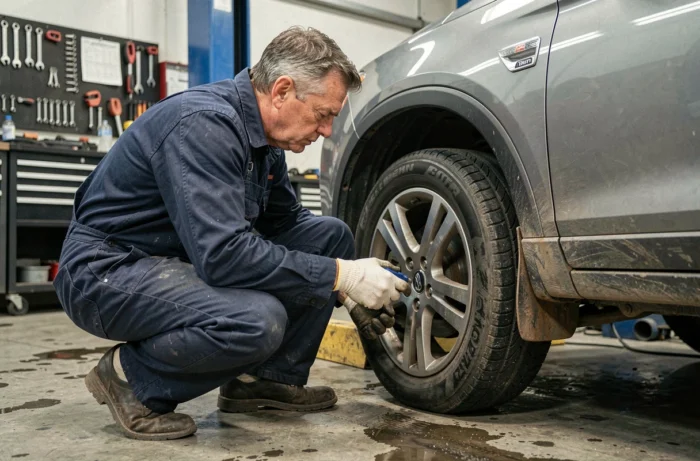
- Tires and asymmetric wear: tires worn on one side reveal a geometry or bushing problem. On an all-wheel-drive SUV, uneven tire wear between axles can damage the central differential.
- All-wheel drive system: if the model has four-wheel drive, test the switch to 4×4 mode (or check that the coupler works) during the test drive. A clunking noise in tight turns indicates a worn CV joint or differential.
- Onboard electronics: use an OBD reader to retrieve stored fault codes. Recent SUVs accumulate sensors, and a turned-off warning light does not mean there are no recorded faults.

Used hybrid or thermal SUV: what the engine type really changes
The choice between hybrid and pure thermal is not just about fuel consumption. In the used market, a well-maintained hybrid often shows less wear on the brakes and transmission than an equivalent thermal vehicle, thanks to regenerative braking.
Toyota hybrid SUVs, for example, benefit from decades of technical experience with their hybrid system. The traction battery is designed to last the vehicle’s lifetime in the vast majority of cases. More recent models like the Dacia Duster or Peugeot 3008 hybrids have fewer years of field experience.
A used plug-in hybrid SUV (PHEV) deserves special attention. If the previous owner never charged the battery, the thermal engine has been constantly engaged while carrying the extra weight of the batteries. Check the actual electric range during the test drive: if it is significantly lower than the manufacturer’s value, the battery may be degraded.
A reliable used SUV is not necessarily the best-selling model or the cheapest to buy. It is the one whose mechanics match your usage, whose maintenance is traceable, and whose Crit’Air sticker will not limit your mobility in two years. Take the time to verify these three points before signing; the rest is negotiable.