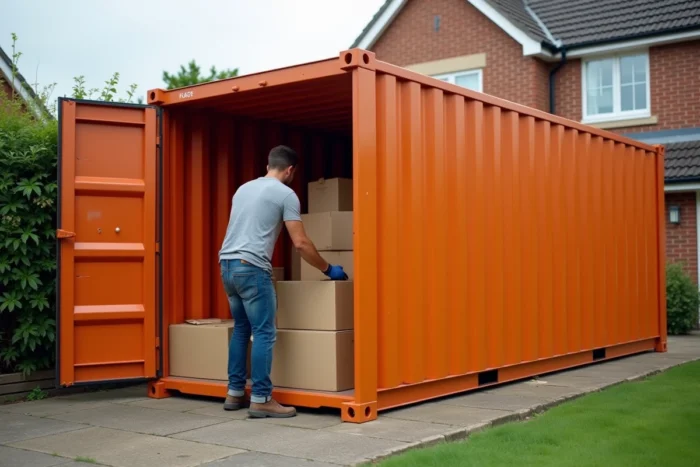
A studio to empty during renovations, a cellar that overflows, a stock of market materials to protect between two seasons: in each of these cases, one quickly encounters the question of the necessary volume. The 4m3 container often comes up as a compact storage option, but its actual capacity remains unclear for many individuals and professionals.
Access constraint to the box: why the 4m3 poses a loading problem
Before listing what can be stored, we must address what is systematically overlooked: the door. A 4m3 container or box offers a limited opening in width and height. You don’t load a three-seater sofa like you stack boxes.
Specifically, the interior height is around two meters, and the usable width of the door is often less than that of the internal wall. The result: any bulky furniture must pass through the opening before being turned inside. A 140 cm bed base, for example, passes diagonally, but a corner sofa simply won’t fit without prior disassembly.
You can find the dimensions of a 4m3 on La Gazette de Constantine, which details the precise interior measurements according to suppliers. These few centimeters of difference between models change the game for the passage of certain pieces of furniture.
The other pitfall is the weight on the ground. A small volume does not mean an unlimited load. For heavy materials (tools, stock of tiles, paper archives), it is necessary to check the maximum allowable load, which varies depending on whether the container is metal, wood, or reinforced textile.
Realistic storage in a 4m3: furniture, boxes, and belongings from a small apartment
Let’s talk practical. A volume of 4 cubic meters is roughly equivalent to a large hallway closet in depth and height. To visualize the space, one can imagine a cube about 1.60 m on each side.
What fits without forcing
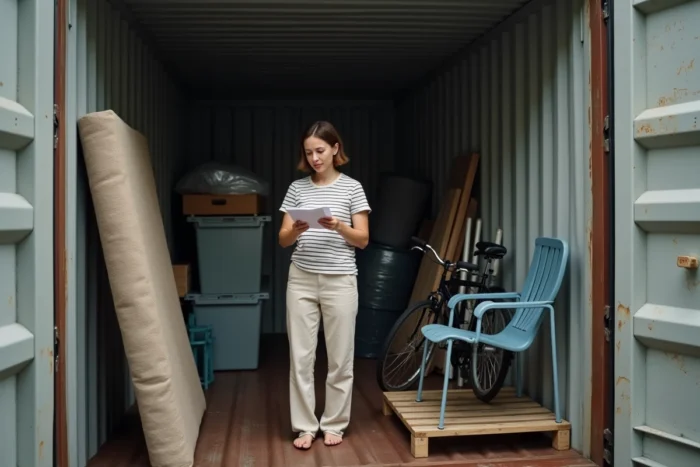
- About twenty standard moving boxes stacked correctly, which corresponds to the contents of a studio or a complete bedroom (clothes, books, dishes, small appliances).
- A disassembled single bed (bed base, frame, rolled or vacuum-packed mattress), a coffee table, and two chairs.
- Seasonal equipment: bicycles, skis, stroller, camping tent, parasol, compact lawn mower. These long but light items make good use of the box’s height.
A 4m3 absorbs the contents of a studio of 20 to 25 m2, provided that the furniture is disassembled and every nook is optimized. This is far from the volume needed for a fully furnished two-room apartment.
What doesn’t fit (or fits poorly)
A standard refrigerator alone takes up a significant portion of the available volume. Add a washing machine and there is almost no space left for boxes. Large appliances saturate a 4m3 in two pieces.
A non-disassemblable sofa, a three-door wardrobe, an L-shaped desk: these pieces of furniture either exceed the width of the door or take up too much floor space to leave useful margin. Feedback on this point varies among providers, as the interior dimensions are not strictly identical from one box to another.
4m3 container for storing water or materials: lesser-known uses
The 4m3 is not just for moving. It is found in contexts where the reduced volume is an advantage, not a constraint.
4m3 concrete tanks are installed to store rainwater in projects aimed at adapting to recurring droughts, particularly in Nouvelle-Aquitaine. Two interconnected tanks of this volume allow for the secure watering of a garden or a small farm for several weeks without connection to the network.
On construction sites, metal containers of this size are used for sorting secondary waste (plaster, wood, cables) or for temporary storage of dry raw materials. Their reduced footprint allows them to be placed in narrow spaces where a 20-foot container would not fit.
Regulations for ground-level storage containers: temporary or permanent
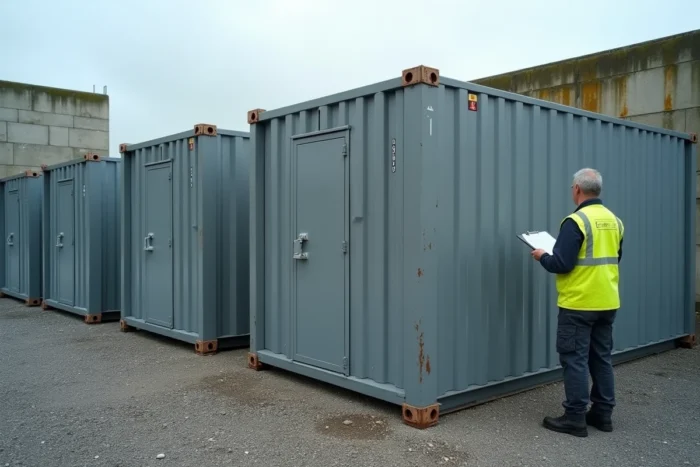
Placing a container in your garden or on a professional site is not trivial from an urban planning perspective. French regulations clearly distinguish between two situations.
A storage container installed for less than three months is considered temporary and generally does not require any authorization, provided it is not located in a protected area (historical monument, classified site, ABF zone).
Beyond three months, the installation becomes permanent. A prior declaration of works must then be submitted to the town hall, or even a building permit if the ground area exceeds a certain threshold or if the local PLU imposes restrictions. For a 4m3 box, the ground area remains modest, but the declaration obligation applies as soon as the storage lasts more than a quarter.
Ignoring this rule exposes one to a formal notice for removal. Several municipalities have tightened their controls on residential containers in recent years, particularly in suburban areas.
Renting a 4m3 box: the criteria that affect the price
The monthly rate for a 4m3 storage space depends on three main variables:
- Location: a box in a densely populated urban area costs significantly more than in the outskirts, sometimes double for the same volume.
- Security and access conditions: video surveillance, 24/7 access, individual alarm per box, presence of a caretaker. The more secure the offer, the higher the rent.
- Duration of commitment: a month-to-month rental without commitment is more expensive per unit than a quarterly or semi-annual contract. Some providers offer progressive discounts.
One often overlooked point: insurance. Most self-storage centers require minimum coverage for stored goods. Check if your home insurance already covers the contents of an external box, which avoids paying for duplicate coverage.
The 4m3 container remains the entry-level format for temporary storage. It is perfectly suited for a bedroom, seasonal stock, or a domestic water reserve, but not for the complete contents of a furnished apartment. Measuring the door before loading the truck remains the most cost-effective reflex.