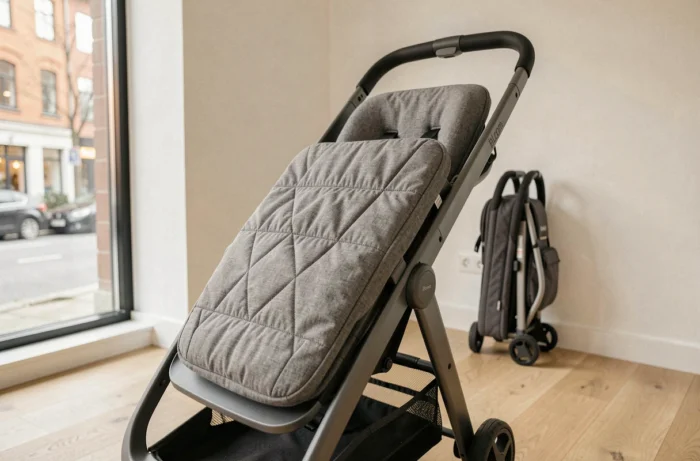
When looking for a stroller for your baby, the question of format quickly arises: should you buy the chassis, carrycot, and car seat separately, or opt for a combined set? The Bloom stroller, offered by the Bebebloom brand, is one of those 3-in-1 systems that brings everything together in one pack. Behind this promise of simplicity, there are a few technical points worth considering before pulling out the credit card.
Car Seat and R129 Standard: The Criterion That Product Listings Don’t Explain
In a 3-in-1 pack like Bebebloom’s, the car seat (infant car seat) is an integral part of the set. We often look at the design of the chassis or the size of the carrycot, but the compliance of the car seat with the R129 standard is the point to check first.
Why this standard in particular? Since the current framework came into effect, new car seats must comply with the R129 regulation (also known as i-Size). The old R44/04 standard is still tolerated for products already in circulation, but any new purchase in 2026 should logically meet the most recent standard.
The concrete difference: R129 classifies seats by the child’s height (rather than weight), imposes stricter side impact tests, and enhances protection in the event of a side impact. For a car seat integrated into a stroller, this means that the safety of the pack depends on the car module, not just the chassis.
A simple reflex before purchasing: look for the orange approval label directly on the car seat. The commercial name or marketing from the manufacturer is not enough. Only this label confirms that the product has actually passed the regulatory tests.
If you are considering exploring the Bloom stroller at Babybloom, make sure that the product listing explicitly details the standard applied to the car seat included in the pack.
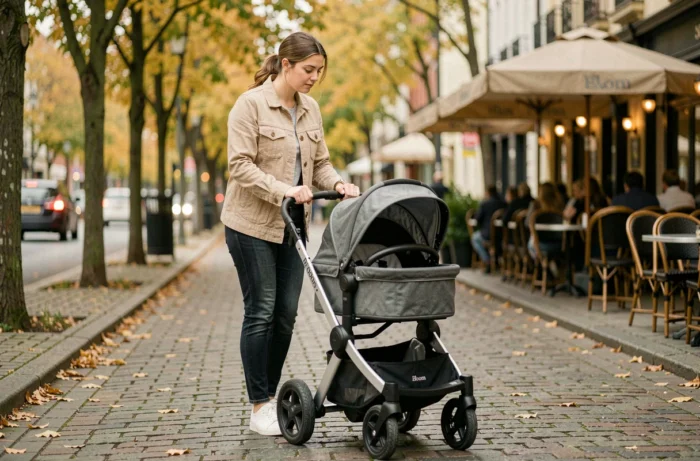
Bloom 3-in-1 Stroller: How the Combined Format Changes Daily Life
You may have noticed how some parents juggle adapters to attach a car seat to a chassis of a different brand? The main advantage of a 3-in-1 system is precisely to eliminate this step. The chassis, carrycot, and car seat are designed to fit together without any intermediate parts.
Bebebloom highlights this argument in its videos: the savings on adapters (often charged separately by competitors) are part of the overall calculation. In practice, this also simplifies transitions. When baby falls asleep in the car, you detach the car seat and clip it directly onto the chassis without waking them up.
Carrycot, Hammock, Car Seat: Three Configurations for Three Ages
The principle of the 3-in-1 relies on three modules used successively:
- The carrycot is used from birth, for walks where the baby remains lying flat. It is suitable for the first months when back support in a horizontal position is still recommended.
- The car seat (rear-facing car seat) takes over for car trips. In a well-designed pack, it also attaches to the chassis for quick errands without taking the baby out of the seat.
- The hammock (seat facing the road or facing the parent) is used when the child can sit up, usually from around six months. This is the configuration that will last the longest.
The benefit of the combined format is not just financial. It is also a matter of space: one chassis instead of two or three separate pieces of equipment to store in the entryway.
Comfort and Ergonomics of the Bloom Stroller: Beyond Design
The sleek design of Bebebloom strollers catches the eye on social media, but comfort for the child (and the parent) relies on more technical details.
The suspension of the chassis determines the actual comfort on uneven terrain. Bebebloom presents its models as all-terrain strollers capable of behaving like city strollers. In practice, this means wheels that are wide enough to absorb cobblestones or park paths while remaining maneuverable on a narrow sidewalk.
Points to Test Before Buying
Comfort cannot be judged from a photo. If you have the opportunity to handle the stroller (in-store or via a showroom), focus on these indicators:
- The height of the push bar: a tall parent and a shorter parent do not push at the same height. An adjustable bar prevents back pain.
- One-handed folding: being able to fold the chassis with one hand while holding the baby with the other radically changes the experience.
- The total weight of the pack: a complete 3-in-1 set can quickly become heavy. Check the weight of the chassis alone, as that is what you will lift to put in the trunk.
- The inclination of the hammock: a backrest that reclines sufficiently allows the child to nap in a semi-reclined position, even while out and about.
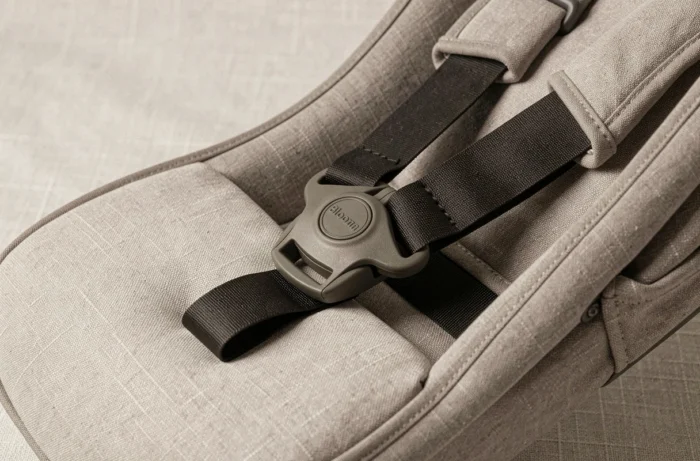
Car Seat Approval Label: How to Read It
This point concerns all parents purchasing a pack with a car seat, regardless of the brand. The orange label sewn onto the car seat contains regulatory information. It indicates the applicable standard (R129 or R44), the height or weight range, and the approval number.
A car seat without a visible approval label should not be used in a car. This is a check that takes a few seconds, but many parents overlook it by relying solely on the seller’s description.
On a Bebebloom set or any other 3-in-1 pack, this label is usually found on the back or underneath the car seat shell. If it mentions R129 and displays a height range (in centimeters), the seat meets the most recent standard. If it mentions R44/04 with a weight range (in kilograms), it is the old standard.
Choosing a combined stroller commits you to several years of use. Taking ten minutes to examine the car seat label and test the folding of the chassis remains the best investment before the purchase, far more reliable than a thirty-second video on social media.