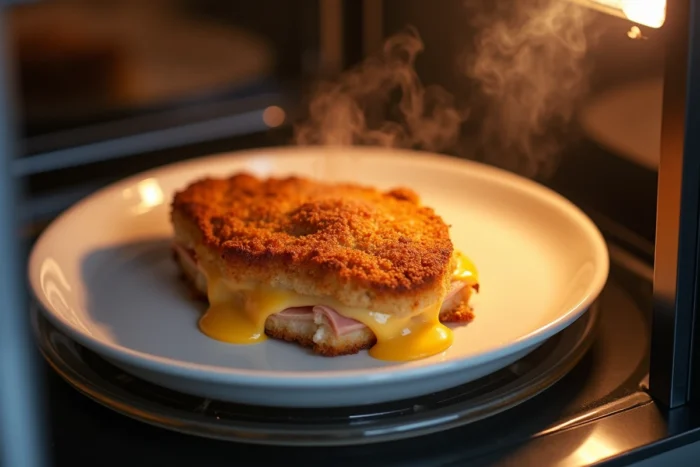
A microwaved cordon bleu loses its texture for a simple physical reason: microwaves excite the water molecules contained in the meat and the coating, causing rapid evaporation that dries out the flesh and softens the breadcrumb. Properly reheating a cordon bleu in the microwave therefore relies on controlling this moisture loss, not just on the heating time alone.
Ring arrangement on the plate: distributing microwave heat
Most guides recommend lowering the power or covering the dish. Even before these adjustments, the way the cordon bleu is placed on the plate changes the outcome. Microwaves do not heat evenly: the center of the plate often receives more energy than the edges, creating hot spots that locally dry out the meat.
Arranging the cordon bleu in a crown shape, that is, offset towards the edge of the plate while leaving the center empty, reduces this imbalance. If several pieces are reheated at the same time, placing them in a ring with space between each piece allows the waves to circulate around each portion.
For a thick cordon bleu, cutting it in half before reheating decreases the thickness at the center. The heat penetrates faster, the heating time shortens, and moisture loss is minimized. This technique works well for a fresh product from the day before as well as for reheating a cordon bleu in the microwave after defrosting.
Medium power and short intervals: the setting that preserves moisture
Running the microwave at full power is the main cause of drying out. At maximum power, water evaporates faster than heat can spread to the center of the cordon bleu. The cheese overheats on the surface, the coating becomes rubbery, and the meat hardens.
Setting the power between 50 and 60% of maximum slows down evaporation while allowing time for heat to spread evenly through the thickness of the piece. Reheating takes a little longer, but the difference in texture is noticeable.
Heating in short intervals with a pause between each cycle further improves the result. During the pause, the heat accumulated on the surface migrates to the center without additional exposure to the waves. Flipping the cordon bleu halfway through compensates for the uneven heating specific to each appliance.
Check the internal temperature
A cordon bleu contains ham and cheese wrapped in poultry. For health reasons, the center must reach a sufficient temperature. Touching the surface does not provide information about the state of the center: if a kitchen thermometer is available, piercing the center remains the most reliable action. The cheese should be melted and the meat hot throughout its thickness.
Damp paper towel and glass of water: two protections against drying out
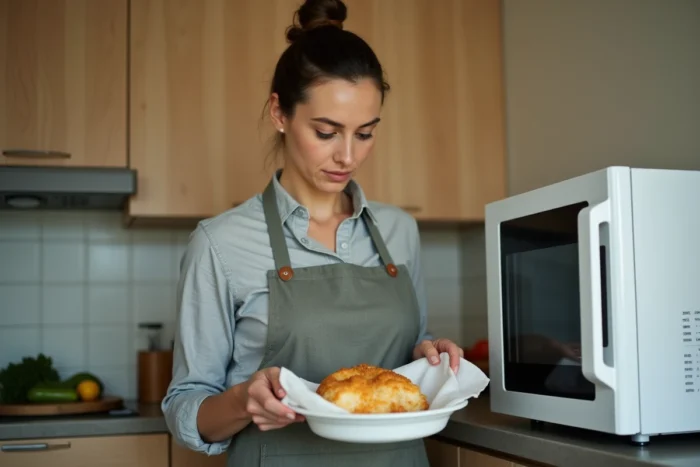
Covering the cordon bleu with a sheet of slightly damp paper towel creates a barrier that limits direct evaporation. The moisture contained in the paper is released gently during reheating, forming a slightly saturated atmosphere around the coating. The result: the breadcrumb remains soft without becoming soggy, and the meat retains its juice.
Placing a small glass of water in the microwave next to the plate acts as an additional humidity regulator. The water absorbs some of the energy from the waves, which reduces the effective power applied to the food and slows down evaporation. These two tips can be combined without issue.
- Dampen the paper towel under a stream of water, then wring it out so that it is just moist, neither soaked nor dry
- Place the paper directly on the cordon bleu without wrapping it, to allow steam to escape from the sides
- Use a glass filled two-thirds full, placed away from the dish so as not to obstruct the rotation of the plate
Post-microwave finishing: restoring the crispiness of the coating
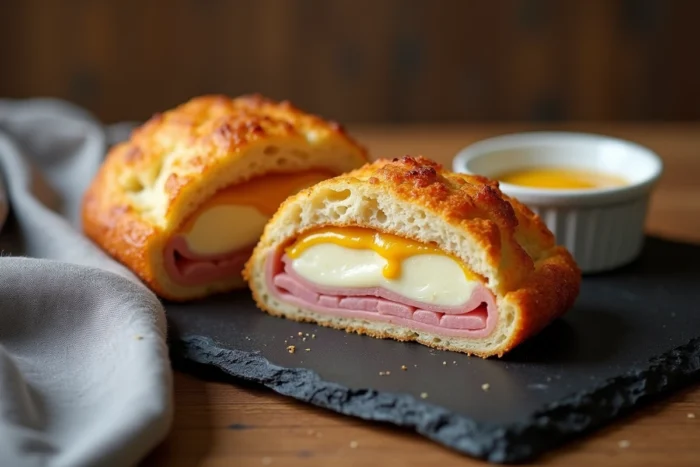
The microwave does not produce a Maillard reaction. The coating cannot become golden and crispy with this appliance alone. Accepting this limitation prevents overheating the cordon bleu in hopes of achieving a crispiness that will not come.
A hot skillet with a drizzle of fat for two minutes on each side is enough to restore crunchiness to the breadcrumb after microwaving. The dry heat of the skillet evaporates the surface moisture without affecting the already reheated interior.
An air fryer produces a similar result in a few minutes, with the advantage of not adding fat. For those who have an already hot oven, a short finish under the broiler achieves the same goal. In any case, the microwave is only used to raise the internal temperature, and the finishing takes care of the exterior texture.
Common mistakes when reheating in the microwave
Some reflexes worsen drying out instead of preventing it.
- Reheating a still frozen cordon bleu without prior defrosting creates icy zones next to burning hot areas, the cheese leaks before the center is hot
- Stacking several cordon bleus on top of each other prevents the waves from reaching the bottom pieces, which lengthens the total time and dries out the top pieces
- Using plastic wrap not suitable for microwaves traps steam excessively and turns the coating into a soft paste
- Starting an additional cycle without checking the temperature pushes the cooking beyond what is necessary
Reheating a cordon bleu in the microwave works when each parameter—arrangement, power, humidity, duration—plays its role. The microwave reheats the center, the skillet or air fryer restores the surface. Separating these two functions results in a cordon bleu that resembles a prepared dish, not a last-minute compromise.