
In 4th grade, writing encompasses several requirements of the French curriculum: mastery of narrative tenses, construction of an argument, textual coherence. These skills are also those evaluated in the written exam of the diploma, the current format of which includes imaginative and reflective topics similar to what is worked on from the fourth grade onwards. Offering writing topics accompanied by detailed corrections allows students to understand what is expected of them, beyond the simple instruction.
Writing in 4th grade and preparation for the diploma: an underestimated link
The writing section of the French exam for the DNB requires candidates to produce a structured text, adhering to specific narrative or argumentative constraints. The expectations focus on mastery of past tenses, the ability to organize an argumentative paragraph, and the overall coherence of the narrative.
These skills are not acquired in just a few weeks of revision in 3rd grade. Regular practice starting in 4th grade conditions success in the diploma. A student who has already written several argumentative or narrative texts with detailed feedback arrives in 3rd grade with writing reflexes that others must build in urgency.
Working on writing topics with corrections for 4th grade offers a double advantage: the student practices on a format close to the diploma, and the correction shows them concretely how to structure their response.

Argumentative writing topics in 4th grade: going beyond the list of themes
Most online resources offer lists of topics without specifying what makes the real difficulty of each. A topic like “Should schools ban mobile phones?” seems simple, but it involves skills that many 4th-grade students have not yet mastered.
What the correction should show
A useful correction is not limited to a model text. It breaks down the expected reasoning. For an argumentative topic, this means making the outline, logical connectors, and progression between arguments visible.
Let’s take a common topic: “Should online learning become a permanent option for middle school students?” The trap for the student is to juxtapose opinions without articulating them. A detailed correction shows how to link each argument to a concrete example, and then how to formulate a nuance or concession in the final paragraph.
- The introduction sets the context and clearly states the chosen position, without beating around the bush for three sentences.
- Each paragraph of the development starts with an argument, followed by a specific example (a fact, a personal experience, a reference to the school curriculum).
- The conclusion does not repeat the introduction: it broadens the reflection or formulates an honest limitation of the defended position.
This type of breakdown helps the student understand that writing an argumentative text follows a reproducible mechanism.
Narrative and imaginative writing: recurring mistakes in 4th grade
Narrative topics (continuation of a text, constrained narrative, short story) represent a significant part of writing assignments in 4th grade. Feedback from teachers highlights difficulties that recur from one class to another.
Temporal coherence and point of view
The mixing of tenses is the most frequent problem. A student starts in the simple past, slips into the present tense, and then returns to the compound past without logic. The correction must point out these breaks and show how to maintain a coherent temporal system throughout the text.
The narrative point of view poses a comparable problem. A student writing a first-person narrative sometimes shifts to an omniscient description, accessing the thoughts of other characters without transition. An effective correction identifies this shift and proposes a rewrite of the relevant passage.
Topics related to digital technology and screens
Subject banks now include themes related to screens and social media. “Describe a day without any screens” or “Imagine a world where social media no longer exists” are topics that motivate students because they relate to their daily lives. However, these contemporary topics require the same narrative rigor as classic themes: story structure, dramatic progression, quality of descriptions.
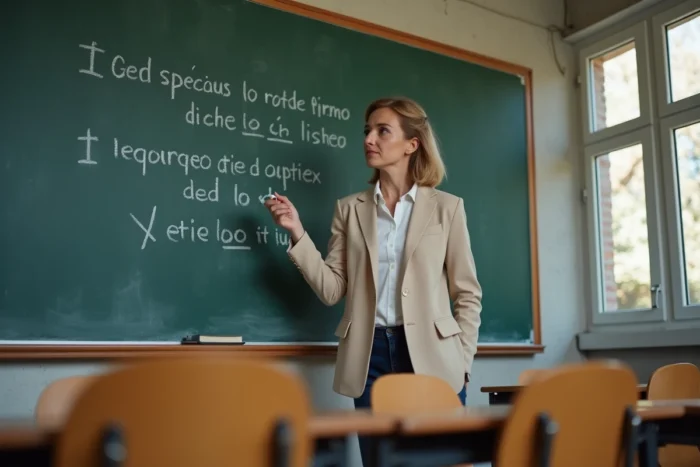
Building a useful writing correction for 4th-grade students
A correction has pedagogical value only if it makes the writing process transparent. Distributing a model text without commentary leaves the student facing a result they do not know how to reproduce.
The most effective method is to present the correction in three distinct layers:
- The annotated outline, which shows the structure before writing (thesis, arguments, examples for an argumentative text, or narrative scheme for a story).
- The written text, with annotations in the margin explaining stylistic choices: why this connector, why this verb tense at this point.
- A “typical error” version that reproduces the most common mistakes and asks the student to correct them themselves, independently.
The “typical error” version is often more educational than the model text. It forces the student to mobilize their grammatical and narrative knowledge in an active exercise, where reading a perfect correction remains passive.
Teachers who dedicate time to collective correction in class observe measurable progress in subsequent assignments. The detailed correction, when used as a working tool and not just as a simple reference, transforms the writing of a daunting exercise into a skill that the student can gradually build, topic by topic.