
Rich listings with a virtual tour attract significantly more views than traditional photo galleries. This observation drives real estate professionals to rethink their marketing chain around mobile applications dedicated to interactive guided tours. The real estate virtual tour is no longer limited to a passive 360° panorama: it becomes a channel for qualifying prospects and a lever for reducing unnecessary travel.
Content update constraint: the overlooked weak point of interactive real estate tours
A real estate guided tour application loses its credibility as soon as the displayed content no longer corresponds to the reality of the property. Changes in home staging furniture, refresh work, modifications in lot availability: every discrepancy between the virtual and the physical generates distrust among buyers.
We observe that most market solutions focus on initial capture (image quality, navigation fluidity) without addressing the content lifecycle. A property that is not updated after renovations undermines buyer trust. The operational challenge is therefore to structure a content update workflow: trigger (end of renovations, furniture rotation), partial or total recapture, synchronized republication on the application and listing portals.
Field teams that integrate a Lamaison360 mobile application for guided tours into their sales process gain responsiveness at this stage, as the scripting of the customer experience requires rethinking each room as a narrative sequence, making visual inconsistencies easier to spot.
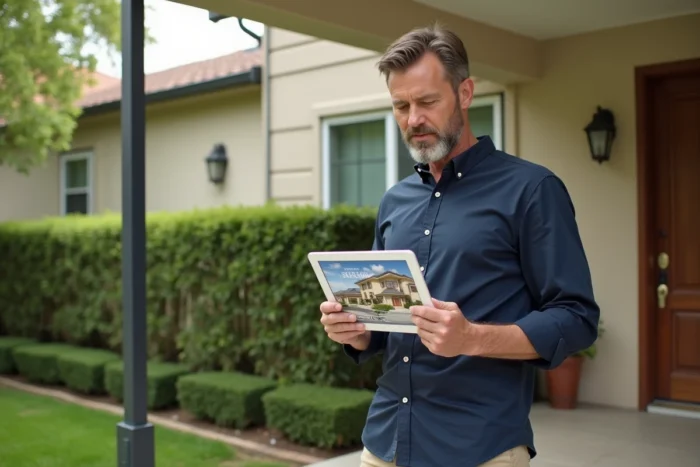
Remote guided tour in real-time: what changes compared to the autonomous 360°
The pre-recorded virtual tour leaves the prospect alone in front of an interactive environment. They navigate at their own pace, but without commercial support. The synchronous guided tour transforms a consultation tool into an active sales channel.
In a remote guided session, the advisor controls or shares navigation with the prospect. They direct attention to the property’s highlights, respond to objections in real-time, and adapt their speech to the buyer’s profile. This synchronized human interaction replicates part of the dynamics of a physical visit.
Features that distinguish a true guided tour from a simple viewer
- Shared camera control allows the advisor to point out an architectural detail while the prospect retains the ability to look around freely.
- The integrated voice or video chat avoids juggling between the tour application and a third-party video conferencing tool, reducing technical friction for the buyer.
- Multi-user management allows the simultaneous presence of multiple decision-makers (couple, family, investor and their wealth advisor), speeding up decision-making without multiplying physical appointments.
These features are not just ergonomic bonuses. They reposition the real estate virtual tour as a filter for qualifying prospects before the physical visit, concentrating travel on truly engaged buyers.
GDPR compliance of interactive real estate tour applications
Guided tour applications collect more data than most agents realize. Navigation paths within the property, time spent in each room, declared preferences via filters, contact details entered to book a visit slot: this personal and behavioral data falls under the scope of GDPR.
Explicit consent management is a requirement, not an option. Specifically, the application must obtain separate consent for each processing purpose (usage statistics, commercial follow-up, sharing with partners). Data minimization requires collecting only what is strictly necessary for the declared purpose.
Points of vigilance for real estate professionals
Data retention periods constitute a frequent blind spot. A prospect who has not followed up after several months should no longer appear in the application’s active database. We recommend setting up an automatic purge aligned with the agency’s average sales cycle duration.
The choice of data host also deserves attention. An application that stores visit paths and prospects’ contact details on servers outside the European Union exposes the agency to additional legal risks, especially if the standard contractual clauses are not up to date.

Mobile real estate tour application: technical criteria for field deployment
The choice of a guided tour application is not solely based on the quality of the 3D rendering. Adoption by sales teams depends on operational constraints rarely addressed in consumer comparisons.
- Cross-device compatibility (smartphone, tablet, computer) without complex installation conditions accessibility for the prospect, who largely refuses to download a dedicated application for a single visit.
- CRM integration allows automatic linking of visit behavior (rooms viewed, duration, questions asked) to the prospect’s profile, enriching commercial scoring without manual re-entry.
- The bandwidth required for a smooth real-time guided session remains a limiting factor in certain geographical areas, particularly in suburban areas where 4G coverage can be uneven.
A smooth mobile experience without downloading conditions the prospect adoption rate. Solutions accessible via browser (webapp) eliminate this friction, provided that the graphic rendering remains immersive enough to convey the property’s volumes and brightness.
The market for interactive real estate tour applications is rapidly evolving towards hybrid platforms combining prospect autonomy and synchronous support. Agencies that structure their capture, update, and data compliance workflows now position themselves with a competitive advantage that is difficult to catch up on once the delay accumulates.