
Estimating the weight of a cast iron radiator requires reasoning by element, not by the complete unit. Each section (or “element”) has its own mass, which depends on the number of columns, height, and thickness of the heating body. Additionally, the water capacity varies according to the profile of the element. Here we detail the calculation method and the technical points that most consumer guides overlook.
Ground load and fixings: the real criterion before any estimation
The weight of a cast iron radiator filled with water directly influences the choice of fixing method and the verification of the support’s load-bearing capacity. A long radiator can easily exceed a hundred kilograms once heated. On an old wooden floor, this load concentrated on two or three support points can cause sagging or even tearing away of the wall brackets.
We regularly observe confusion between the role of wall brackets and that of the feet. The feet bear the majority of the vertical load, while the wall brackets mainly serve to keep the radiator upright against the wall. Undersizing the feet or removing them in favor of simple brackets exposes the radiator to falling, resulting in broken connections and water damage.
Before estimating the weight, identify the type of support: concrete slab, wooden floor on joists, plasterboard partition. On a joist floor, we recommend positioning the feet directly above a joist or distributing the load using a metal plate.
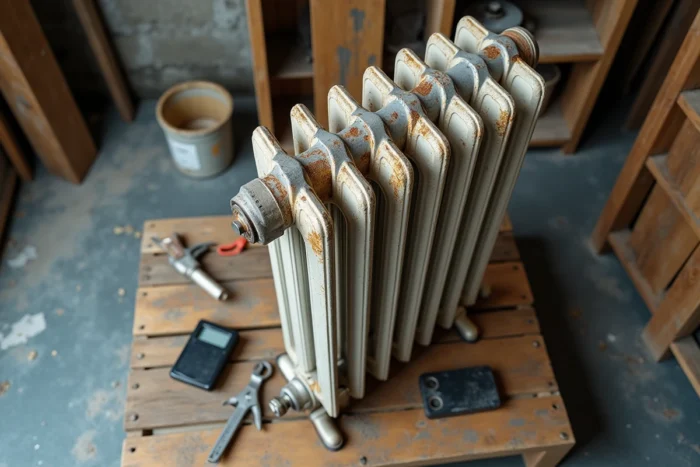
Calculation method for the weight of an empty and filled cast iron radiator
The calculation is based on a unit value: the empty mass of a single element. This varies according to the model. A two-column element does not weigh the same as a four or six-column element. Height also plays a role: a low-height element (designed to fit under a window sill) weighs significantly less than a standard element.
To obtain the weight of a cast iron radiator with water, the formula is simple: multiply the empty unit mass by the number of elements, then add the total water capacity. Don’t forget to account for approximately one kilogram for the plugs and reducers on each side.
The variables to note on the radiator
- The number of columns visible on the edge (2, 3, 4, or 6 columns for common models, sometimes special profiles like Savane or Floréal).
- The total height measured from the bottom of the foot to the top, including the feet if they are integrated into the heating body.
- The number of elements, counted by looking at the radiator from the front: each vertical “wave” corresponds to one element.
Without these three data points, any estimation remains approximate. We advise against relying on a generic “average weight”: the difference between a two-column and a six-column of the same height can be from simple to triple.
Water capacity per element: why it changes everything
Water represents a significant fraction of the total weight. A filled cast iron radiator can weigh a third more than the same empty radiator. This difference has direct consequences during disassembly, transport, or load calculation on a floor.
The water capacity per element depends on the internal volume of the heating body. Two-column models contain less water per element than six-column models, but the relationship is not strictly proportional to the number of columns: the thickness of the walls and internal geometry vary from one manufacturer to another.
Empty weight versus heated weight: principle table
| Profile | Empty mass per element | Water capacity per element | Heated mass per element |
|---|---|---|---|
| 2 columns, standard height | Low | Low | Moderate |
| 4 columns, standard height | Medium | Medium | High |
| 6 columns, standard height | High | High | Very high |
The exact values depend on the specific model. We recommend consulting the manufacturer’s technical documentation or weighing an isolated element using a scale to obtain a reliable basis.
Common errors when estimating the weight of a cast iron radiator
The first error is forgetting residual water. Even after draining and purging, water remains trapped in the lower columns if the radiator is not tilted. During removal, we recommend slightly tilting each end over a container to drain this residual water, which can represent several kilograms.
The second error is confusing the number of columns with the number of elements. Columns are counted on the thickness (the edge), while elements are counted on the width (the face). A radiator “4 columns, 12 elements” does not weigh the same as a “2 columns, 12 elements”.
- Always check the edge of the radiator to identify the number of columns: feel behind if the radiator is against the wall.
- Count the elements from the front, identifying each vertical rib separated by a joint or nipple.
- Measure the total height with a tape measure, not by visual estimation: low-height models are more common than one might think.

Moving or removing a cast iron radiator: anticipating the actual mass
During a renovation, removing a filled cast iron radiator by two people can be dangerous if the actual weight has been underestimated. Always drain and purge before any handling. Even empty, a long radiator remains difficult to carry: plan for a reinforced dolly or suitable carrying straps.
Defective fixing is a documented risk factor based on feedback from heating professionals. A heavy radiator that is poorly fixed can detach, break connections, and cause water damage. If you are working on an old radiator, check the condition of the brackets, the load-bearing wall, and the feet before any reinstallation.
The weight of a cast iron radiator, whether empty or filled, is not an abstract figure. It is a sizing parameter that determines the safety of the installation, the choice of fixings, and the feasibility of removal. Three measurements are sufficient to obtain a reliable estimate: number of columns, total height, number of elements. The rest is multiplication.