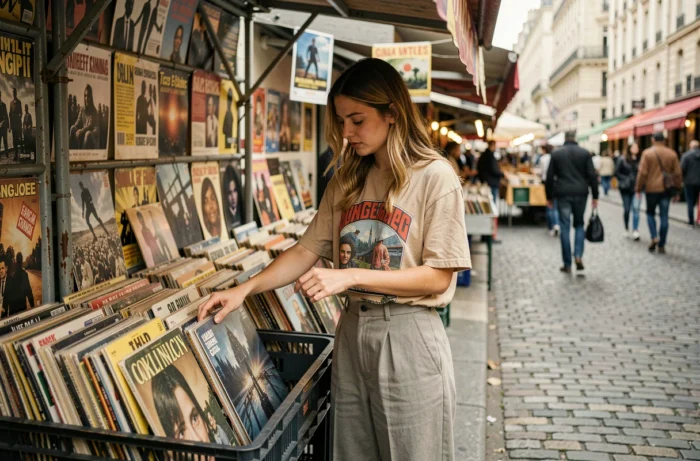
Rap dominates playlists, festivals are sold out, cities compete with cultural projects, and yet the majority of young urbanites report having reduced their cultural spending. This paradox shapes the urban, musical, and cultural news of this season. Understanding these dynamics allows us to identify the trends that matter and distinguish lasting discoveries from fads.
Urban Music and Cultural Budget: The Gap Shaping Young People’s Practices
Have you noticed that rap and hip-hop remain omnipresent in the streets, public transport, and stories, even as cultural outings become increasingly expensive? It’s not just an impression. According to a study by the E.Leclerc Observatory of New Consumption conducted by Viavoice in July 2026, 61% of 18-24 year-olds favor rap, hip-hop, and urban music.
At the same time, 83% of those under 35 report having reduced their cultural spending in at least one area over the past twelve months. Specifically, this means fewer concert tickets purchased, fewer subscriptions accumulated, and fewer outings to the cinema or theater.
Urban music endures because it primarily circulates online. Music streaming, live performances on social media, and clips on YouTube cost nothing or almost nothing. The attachment to these genres remains strong, but young people consume differently: less ticketing, more free content. Cultural media that cover this news in real-time, such as Triplel Le Mag, capture this reality well by blending pop culture, musical outings, and urban life in a single editorial space.
Culture Pass in 2026: Bonus and Access to Local Practices
To compensate for this budgetary decline, public authorities are adjusting their measures. The Culture Pass, launched several years ago, saw a notable shift in 2026: a bonus of 50 euros for young people under certain income conditions or with disabilities was implemented.
Why this choice? The initial observation is simple. Tickets for live performances (concerts, theater, dance) represent a spending category that many young urbanites prioritize cutting first when their budget tightens. The bonus specifically targets these “on-site” practices, those experienced in a location, in a city, with a local anchor.
This measure marks a shift from the earlier versions of the Pass, which were often used to buy books or online subscriptions. The stated goal is to bring young people back to local culture:
- Concerts in local venues rather than large national festivals, often financially out of reach
- Live performances (theater, dance, circus) accessible through the collective part of the Pass in schools
- Neighborhood cultural venues (media libraries, third places, community galleries) that program free or reduced-price events
The gap persists, however, between the event offerings highlighted by major media and the actual practices of young urban audiences. Star festivals capture media attention, but actual attendance occurs elsewhere, in more modest and less covered venues.
Regulation of Urban Festive Cultures: What Changes Practically
Urban news is not limited to traditional cultural outings. Informal festive practices (free parties, spontaneous gatherings, ephemeral scenes) are an integral part of the musical life of cities. They have recently come under stricter legal regulation.
The Constitutional Council has validated the main measures of the Ripost law, which tightens the framework around several practices:
- Free parties are subject to heavier administrative penalties, with lowered tolerance thresholds
- Unregistered festive gatherings in public spaces are now subject to stricter prior notification requirements
- Local authorities have expanded margins to regulate noise and temporary occupation of urban space
These legal constraints directly alter the festive landscape of cities. Organizers of informal parties are moving to suburban areas or private venues. Emerging scenes that relied on this underground economy are losing visibility.
For urban music enthusiasts, the result is paradoxical. The legal offer is structuring (certified venues, municipal programming, artist residencies), but part of the musical creativity is migrating to less accessible spaces. Following urban cultural news requires looking beyond official programming.
Cities and Cultural Ambitions: The Example of Local Policies in France
Several French cities are showcasing ambitious cultural strategies this season. Strasbourg, for example, is outlining a policy that articulates heritage renovation (its opera is undergoing a transformation project) and support for contemporary creation. Marseille continues to rely on its museums and heritage to attract audiences and artists.
These local dynamics deserve attention because they concretely determine what residents and visitors can see, hear, and discover. A city that invests in a network of mid-sized concert halls does not produce the same musical scene as a city focused on a single large cultural facility.
Cultural news is also read through the budgetary decisions of local authorities. The recent elimination of certain support structures (such as the GIP EPAU, dedicated to urban planning and development) illustrates the tensions between budgetary savings and maintaining a vibrant cultural ecosystem. When one link disappears, artist residencies, neighborhood programming, or cultural mediations quietly fade away.
Identifying significant urban cultural trends requires crossing multiple lenses: the actual practices of young audiences, access measures like the Culture Pass, the legal framework of festive cultures, and the political choices of cities. The most stimulating discoveries of this season are not necessarily those making headlines, but those emerging at the intersection of these dynamics, where music, art, and urban life meet without intermediaries.