You planted a pittosporum kohuhu hoping to enjoy an enchanting fragrance in your garden, but you don’t smell anything special at flowering time? This discrepancy between the promise of nursery labels and the reality on the ground is common. The pittosporum tenuifolium, commonly known as kohuhu, does produce flowers, but their scent remains a topic of debate among gardeners. It all depends on factors that product sheets rarely mention.
Fragrance of the pittosporum kohuhu: a real but very subtle scent
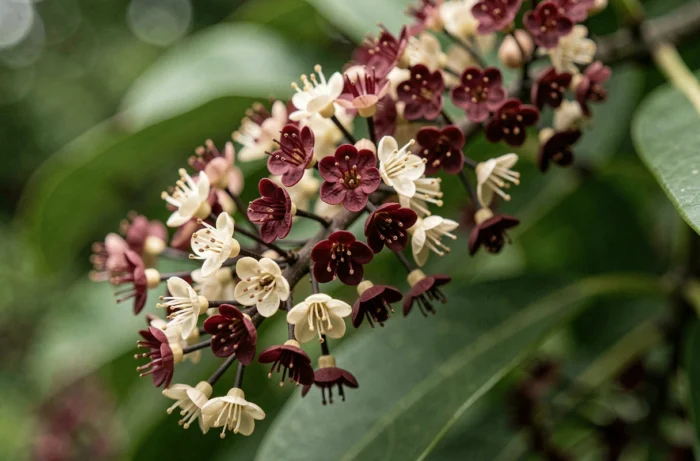
The kohuhu blooms at the end of spring. Its small, often dark purple flowers appear in discreet clusters at the tips of the branches. They blend into the foliage to the point of going unnoticed unless you look for them.
The fragrance does exist. It is generally described as slightly sweet, reminiscent of honey. Some gardeners compare it to a muted version of orange blossom. However, this scent is nothing like that of jasmine or lilac, which can fill an entire corner of a terrace.
The nuance lies in a specific point: the fragrance is mainly perceptible at the time of anthesis, that is, when the flower is fully open. This olfactory peak lasts only a short time. If you pass by your hedge at another time of day, or a few days after the flowers have opened, you will probably not smell anything. It is not a “massive” fragrance that spreads from a distance.
To learn everything about the pittosporum kohuhu, you must first accept this reality: its main interest remains the evergreen foliage, not the fragrance.
Cultivar, pruning, and exposure: why some kohuhu have no scent
You may have a neighbor who swears that their pittosporum scents the garden, while yours remains silent. Three factors explain these discrepancies.
The choice of cultivar changes everything
The genus Pittosporum includes over 200 species. Among them, Pittosporum tobira (Japanese pittosporum) is renowned for its white flowers with a strong and powerful scent, reminiscent of orange blossom. The tenuifolium, on the other hand, belongs to a different category: its fragrance is significantly more subtle than that of tobira.
Among the cultivars of tenuifolium, variability is great. Variegated or colored foliage forms (like ‘Variegatum’, ‘Elizabeth’, ‘Golden Ball’) are often selected for their visual appeal, not for their ability to bloom abundantly. A cultivar chosen for the color of its leaves sometimes produces fewer flowers, and therefore less fragrance.
Severe pruning reduces flowering
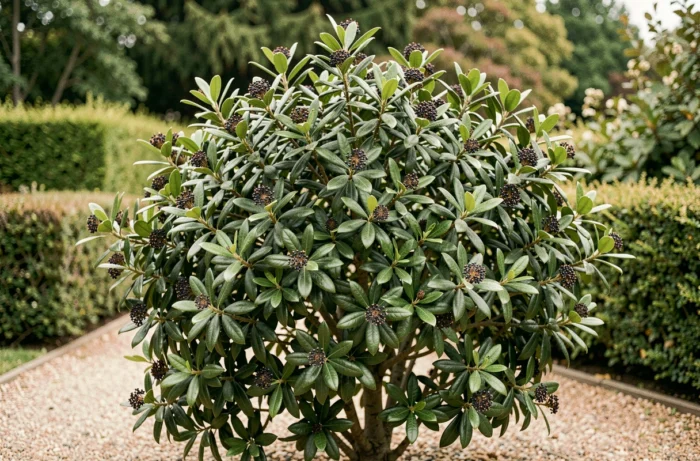
The kohuhu tolerates pruning very well, making it a popular candidate for hedges. The downside of this quality: too frequent or too severe pruning removes the branches that bear flower buds. A subject pruned into a compact ball twice a year is unlikely to bloom properly.
If fragrance interests you, it is better to prune lightly after flowering rather than before. Allowing the shrub to take on a more natural shape encourages bud formation.
Exposure and drainage make a difference
A pittosporum planted in partial shade in heavy, wet soil will not bloom as much as one in full sun in well-drained soil. The quality of drainage remains a determining factor: in poorly drained soil, the shrub may decline or stagnate, which mechanically reduces flowering and the perception of fragrance.
- Exposure: full sun to light partial shade, sheltered from cold winds
- Soil: well-draining, no water stagnation at the base, even in winter
- Pruning: moderate, after flowering, to preserve future buds
Pittosporum tobira or tenuifolium: which shrub to choose for fragrance
If your priority is to have an evergreen AND fragrant shrub, choosing the right pittosporum is the real question. Here’s what distinguishes the two most common species in gardening.
| Criterion | P. tenuifolium (kohuhu) | P. tobira (Japanese) |
|---|---|---|
| Fragrance | Subtle, sweet, detectable up close | Pronounced, orange blossom, detectable from a distance |
| Flowering | Small purple flowers, late spring | Creamy white flowers in clusters, May-June |
| Hardiness | Better tolerance to moderate cold | More frost-sensitive, prefers coastal or mild climates |
| Use | Hedges, decorative foliage | Flower beds, fragrant hedges |
The tobira is the pittosporum to choose if fragrance is your main criterion. The kohuhu, on the other hand, shines with the diversity of its foliage (purple, silver, variegated) and its ability to form dense, evergreen hedges. These are two complementary shrubs, not interchangeable.
Flowering of the kohuhu: what to expect in the garden
Expect small, almost insignificant flowers visually. Their dark color (purple to chocolate brown) makes them less visible among the green or variegated foliage. It is a shrub that does not put on a “floral show”.
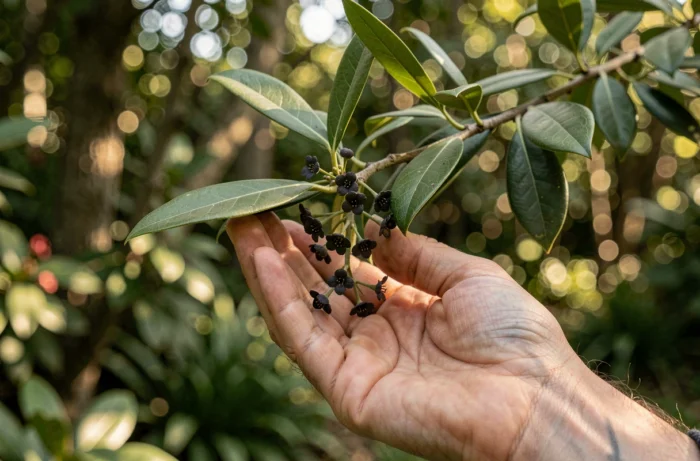
At the end of flowering, capsules appear and eventually open at maturity. This detail often goes unnoticed, but the sticky seeds inside the capsules are characteristic of the Pittosporum genus, whose name literally means “resinous seed”.
To increase your chances of perceiving the fragrance, approach the shrub in the late morning on a calm, sunny day. This is when the open flowers release the most volatile compounds.
- Period: late spring, over a few weeks
- Type of flowers: small, dark, grouped in terminal clusters
- Fragrance: light, sweet, honey-like, detectable only up close
- Fruits: capsules that open at maturity, sticky seeds
The pittosporum kohuhu remains an excellent choice for structuring a garden with elegant, evergreen foliage year-round. Its fragrance is a subtle bonus, not a central argument. Gardeners seeking a fragrant hedge would do well to pair the kohuhu with a tobira or another shrub with a more generous flowering fragrance, rather than relying solely on it to scent the terrace.