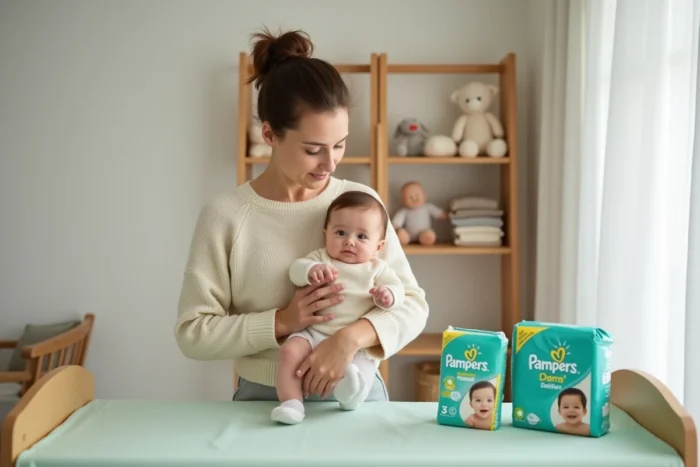
The baby’s weight determines the size of the diaper, not the range. Choosing between Premium Protection, Baby-Dry, or Harmonie depends on other factors that competitors rarely address: the composition of the contact layer, the structure of the leak-proof barrier, material certification, and, most importantly, the parent’s living context at the time of purchase.
Contact layer and absorbent core: what really differentiates Pampers ranges
The technical distinction between Pampers ranges primarily lies in the contact layer with the skin. Premium Protection uses a micro-perforated layer designed to limit moisture transfer to the epidermis. Baby-Dry focuses on a reinforced absorbent core, designed for long periods without a change (night, travel).
Harmonie positions itself differently. Its layer is made from plant-based fibers, and the range highlights the absence of fragrance, lotion, and chlorine bleaching. We observe that this distinction in composition attracts parents sensitive to certifications, but it does not automatically guarantee better skin tolerance for every baby.
To delve deeper into the difference between Pampers diapers on Dr Hackney, one must look beyond marketing and compare technical specifications range by range.
In practice, the choice of layer and absorbent core determines the necessary change frequency. A more efficient absorbent core does not exempt one from regularly checking the state of the diaper, but it offers a useful safety margin at night or while on the go.

Choosing a Pampers range based on the parent’s life stage
Reasoning solely by the baby’s weight leads to ignoring a crucial factor: the parent’s daily situation. The change frequency, monthly budget, and childcare mode radically alter the relevant range.
Neonatal period and parental leave
During the first weeks, the number of daily changes is high. The newborn’s skin is particularly reactive. In this context, we recommend a range focused on the softness of the layer and a clean composition, such as Premium Protection or Harmonie.
The parent on leave changes the diaper frequently, which reduces the need for a very high-capacity absorbent core. The priority criterion here is skin tolerance, not absorption duration.
Return to work and childcare
When the baby enters daycare or with a nanny, changes are spaced out and standardized. Baby-Dry, with its reinforced leak-proof barrier and long-lasting absorption, becomes more suitable.
The unit price also matters more at this stage, as the parent buys in bulk and compares pack sizes. Baby-Dry generally offers a competitive unit price/absorption ratio among the brand.
Baby gift and diaper cake
Pampers positions certain ranges as suitable for diaper cakes, particularly Premium Protection and Harmonie. For a gift, the choice falls on a range perceived as “premium” by the recipient, regardless of the baby’s actual technical needs. This is a use where the image of the range takes precedence over absorbent performance.
Composition and certification: decoding the Pampers label
The composition of Pampers diapers varies by range, and this variation has concrete consequences for sensitive skin.
- Harmonie highlights the absence of elemental chlorine bleaching, fragrance, and lotion. It emphasizes plant-based materials for the outer layer and the contact layer.
- Premium Protection and Baby-Dry may contain protective lotions and moisture indicators whose chemical composition differs from one range to another.
- Pampers communicates about hundreds of sensors in factories and more than 2000 daily checks in its manufacturing processes, a traceability argument particularly emphasized for Harmonie.
The presence or absence of certification (such as OEKO-TEX or dermatological label) is not systematically indicated on the packaging of all ranges. We recommend checking directly on the manufacturer’s website rather than relying on packaging in-store.
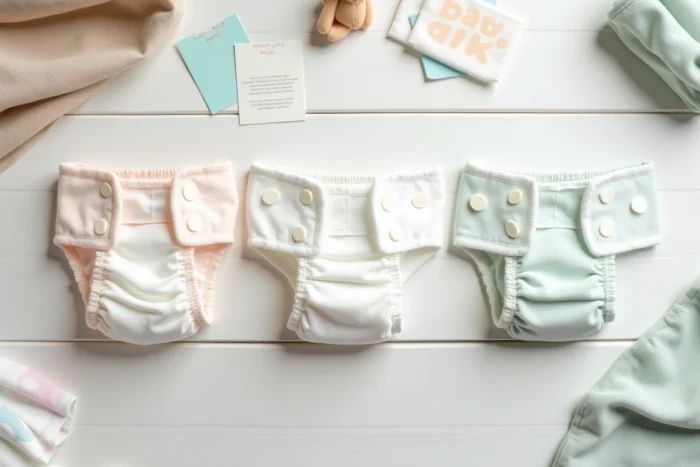
Leaks and barriers: which model for which use
Leaks remain the number one dissatisfaction criterion among parents, across all brands. At Pampers, the design of the leak-proof barrier varies from one range to another.
Baby-Dry incorporates absorption channels designed to distribute moisture across the entire surface of the absorbent core. Premium Protection focuses on a tighter fit around the thighs and waist. The choice between these two approaches depends on the baby’s morphology, not just their age or weight.
A baby with thin thighs will experience more leaks with a model that has wide barriers. Conversely, a chubby baby will be better held by a diaper with soft but enveloping elastics. Testing two ranges for a week each remains the most reliable method to decide.
Classic diapers or training pants
Training pants (Pants) are worn like underwear. They are suitable for mobile babies who make changing on the table difficult. This format exists in several ranges (Baby-Dry Pants, Premium Protection Pants, Harmonie Pants).
- Pants facilitate standing changes, particularly useful when traveling or in groups.
- Their unit price is higher than that of classic diapers in the equivalent range.
- Absorption is comparable, but the fit differs: Pants are held by a circular elastic at the waist, which is better suited for very active babies.
The transition to training pants should not happen too early. As long as the baby is not moving actively, the classic diaper offers a more precise fit and a better value for money.
Choosing a Pampers range involves crossing three variables: the baby’s skin sensitivity, their morphology, and the parent’s lifestyle. Weight determines size, not range. Testing for a short period before buying in bulk avoids unpleasant surprises, regardless of the chosen model.