What outdoor activities offer the best balance between physical engagement, family accessibility, and real immersion in nature? This question is worth asking at a time when the range of outdoor workshops and stays is diversifying, including treetop courses, guided hikes, mountain biking, soft survival courses, and multisport camps. The differences in format, duration, and target audience make comparison less straightforward than it seems.
Comparison of outdoor workshop formats by duration and audience
The nature activities market is structured around three main formats, each with distinct characteristics. The table below summarizes the differences observed among the main operators analyzed.
| Format | Typical Duration | Main Audience | Dominant Activities | Supervision |
|---|---|---|---|---|
| Day / Half-Day Workshop | 2 h to 6 h | Families, children from 6 years | Treetop courses, disc golf, exploration games, net courses | On-site facilitators, variable ratio |
| Multi-Day Workshop (Camp) | 3 to 7 days | Children 6-12 years, teens 12-17 years | Hiking, bivouacking, mountain biking, climbing, navigation | Qualified guides, groups of 8-12 |
| Immersive Stay / Autonomy | 5 to 14 days | Teens, young adults | Soft survival, camp building, wildlife observation | Nature educators, reduced ratio |
Day workshops are suitable for families looking for a one-time outing without heavy logistics. In contrast, multi-day camps and immersive stays require a stronger commitment, both financially and physically.
Organizations like Exp Nature offer packages that cover several of these formats, allowing for the immersion level to be adapted to the participant’s profile.
Outdoor activities in the mountains or forests: how the terrain changes the experience
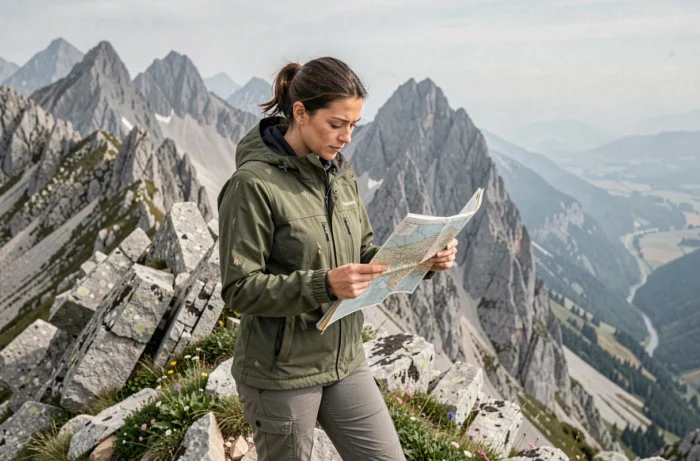
The choice of terrain radically alters the nature of the experience. A workshop in the mountains (Vallée des Belleville, Jura massif) naturally incorporates elevation changes, altitude effort management, and more pronounced weather constraints. The resulting activities, such as climbing on natural sites, high-altitude hiking, and navigation on technical trails, demand more physical fitness.
A course in a plain forest or coastal area emphasizes different skills. Environmental reading (fauna, flora, tracks), shelter building, and exploration games are more accessible to young children in these settings.
Selection criteria based on terrain
- Mountain: suitable for children from 8 years in supervised workshops, requires specific equipment (hiking shoes, layered clothing), and supervision by qualified guides
- Forest / countryside: accessible from 3-6 years for “mini-adventurer” formats, lightweight equipment, strong educational component (species recognition, land art)
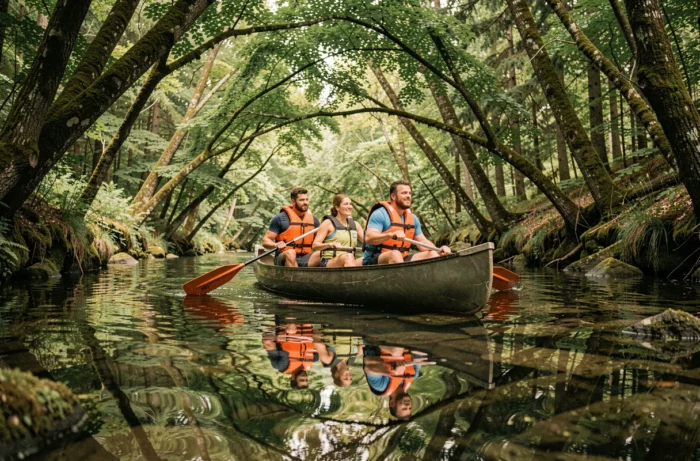
- Coastal / river: adds a water dimension (snorkeling, kayaking), but involves enhanced safety standards and increased supervision, especially during summer
Mountain operators often structure their offerings by strict age groups (3-6 years, 6-10 years, 8-12 years, 12-17 years), reflecting the differences in physical capacity and autonomy between these groups.
Safety and heatwave: adapting outdoor workshops to real conditions
Recent French health recommendations have introduced a constraint that many activity catalogs do not mention. Outdoor physical activities must be adapted or moved below approximately 32 °C, favoring morning and evening slots, with a reduction in duration and intensity during heatwaves.
This information changes the game for summer workshops. A mountain biking camp scheduled in July in southern France does not take place under the same conditions as an identical workshop in Brittany or mid-mountain.
Concrete points of vigilance
The documented increase in emergency room visits related to heat and drownings during heatwave episodes requires organizers to revise their protocols. A serious outdoor workshop now includes:
- An indoor or shaded fallback plan in case of exceeding the thermal threshold
- Adjusted activity schedules (departure before 9 a.m., resuming after 5 p.m.)
- An increased supervision ratio for water activities, as improvised swimming poses a major risk during high heat
- Permanent access to drinking water and mandatory breaks, not just suggested
Checking an organizer’s heatwave protocol before registration is still a reflex not widely adopted by parents, even though it is a reliable indicator of the organization’s seriousness.
Slow nature tourism: a growing format for families
Since 2024, several tourist offices have structured “gentle” outdoor offers less than an hour from major cities, designed for families with children aged 6 to 12 years. The principle: minimal travel, slowed pace, authentic experiences rather than a collection of thrilling activities.
This format contrasts with the classic adventure park model (treetop courses, laser tag, trampo bungy) where the logic is one of individual tickets and rapid rotation. Slow nature tourism focuses on a half-day or full day in the same location, with observation, foraging, free walking, and embraced downtime.
For families torn between a multisport park and an immersive nature workshop, the determining criterion remains what the child retains two weeks later. Feedback documented by specialized organizations shows that activities based on autonomy (building a shelter, following a trail, identifying a bird) create a more lasting memory than purely thrilling courses.
Ultimately, the choice of an outdoor workshop depends less on the activity catalog offered than on three measurable variables: the supervision ratio, adaptation to the terrain and weather conditions, and the depth of the experience relative to its duration. A three-day workshop in the forest with a group of eight children and a qualified nature educator offers more than a week of rotation between standardized workshops.