
The alphabetical filtering remains underutilized for creating a coherent manga collection. The letter C, however, concentrates several pillars of the shonen catalog, niche seinen, and a few editorial oddities whose longevity far exceeds their initial notoriety. We review the series that deserve a place in a structured collection.
Cataloging by Initial: A Curation Filter More Relevant Than It Seems
Recommendation lists generally categorize by genre, demographics, or raw popularity. Alphabetical sorting, on the other hand, forces a cross-examination of registers that the reader would never have brought together. This is precisely its interest.
The letter C brings together mainstream shonen like Captain Tsubasa with atmospheric seinen like Cesare or fantastic titles like Claymore. This proximity requires evaluating each series on its own narrative qualities, without the bias of the dominant genre.
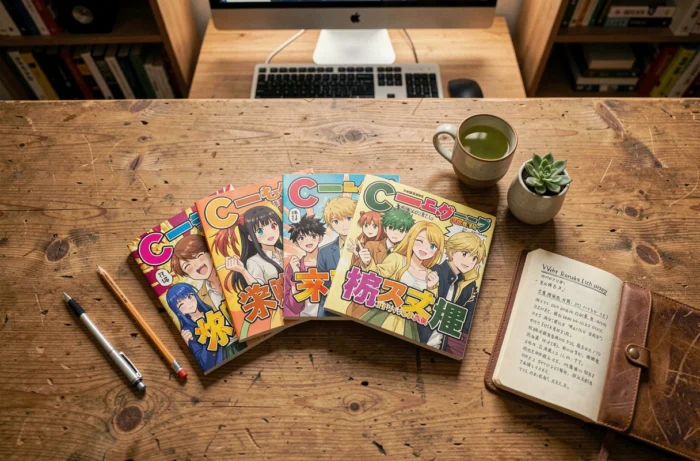
For those looking to explore famous mangas starting with C exhaustively, the volume of titles available in French edition exceeds one hundred. Here, we focus on series whose editorial impact or writing quality justifies a long-term reading investment.

Shonen in C: City Hunter, Captain Tsubasa, and the Narrative Standards of the Genre
City Hunter (Tsukasa Hojo, 35 volumes) remains a case study in episodic narration. Each arc fits into a few chapters, with a comedy-action balance calibrated to the chapter. The series established a model of an adult protagonist in a shonen magazine, which was far from the norm at its pre-publication.
Captain Tsubasa (Yoichi Takahashi) structured the sports manga as we know it. The dramatization of technical gestures, the time skips between matches, and the escalation of stakes from tournament to tournament have been adopted by nearly all sports titles published since. In terms of influence on the genre, Captain Tsubasa defined the narrative grammar of sports manga.
Demon Slayer and the Kimetsu no Yaiba Phenomenon
Listed here under its alternative title for the C of “Demon Slayer,” Demon Slayer (Koyoharu Gotouge, 23 volumes) proved that a short series could dominate the market. The pacing remains a model of efficiency: arcs of three to five volumes, linear power escalation, no filler.
The narrative density of each volume justifies re-reading. Secondary characters have a compressed but functional backstory, which is rare in such a brief shonen.
Seinen and Niche Titles Starting with C: Claymore, Cesare, Cells at Work
Claymore (Norihiro Yagi, 27 volumes) occupies a unique place. The manga is set in a dark fantasy universe where female protagonists carry all the action and military strategy. The power system, based on the control of yoki, introduces a progression mechanic where each level crossed brings one closer to the point of no return. This constant tension distinguishes Claymore from conventional combat series.
- Cesare (Fuyumi Soryo, 13 volumes) transposes the Italian Renaissance with an unusual documentary rigor for a manga. The political intrigues between papal families serve as a narrative engine, and the architectural drawing reflects extensive reference work.
- Cells at Work (Akane Shimizu, 6 volumes) popularizes human immunology through the personification of cells. The concept, seemingly light, is based on scientific accuracy validated by health professionals in Japan. The short format makes it an effective entry point for an audience unfamiliar with manga.
- Chi, a Cat’s Life (Konami Kanata, 12 volumes) targets a young readership with a kodomo whose graphic simplicity masks a well-mastered sense of comedic rhythm. The series has helped expand the manga audience in general bookstores in France.
The French Manga Market and the Place of C Series in Sales
The French manga market is going through a stabilization phase after the post-lockdown peak. According to Actualitté, around 31 million mangas were sold in France in 2025, with a turnover close to 280 million euros. These volumes remain significantly higher than the level of 2019, but the decline of about 13% in volume over one year signals a return to more sustainable consumption rates.
In this context, the overproduction of titles weighs on shelf visibility. Manga accounts for nearly one comic book sold out of two in volume in France, but the number of publishers and monthly new releases makes selection more difficult for the reader.
C Series Facing Editorial Saturation
Established titles like City Hunter or Captain Tsubasa benefit from regular reissues (perfect editions, deluxe editions) that ensure their continuous presence in bookstores. Shorter series like Cells at Work or Chi suffer more from the rapid rotation of new release tables.
The shift to digital is also reshuffling the cards. In Japan, digital manga sales now exceed those of print. In France, this transition is slower, but it favors catalog titles whose physical availability is decreasing. Finding a complete Cesare or Claymore in a bookstore can sometimes be a challenging quest, while digital platforms maintain access to all volumes.
Selection Criteria for Building a Coherent Collection Around the Letter C
We recommend structuring acquisitions around three axes rather than accumulating series as discoveries arise.
- Completion of the series: prioritizing finished mangas (Claymore, Cells at Work, Demon Slayer) helps avoid editorial abandonments and guarantees a complete reading experience.
- Availability in French edition: check if the publisher keeps the first volumes in print. Series that are out of print physically are often still available digitally, but at a cumulative cost sometimes higher than the print edition.
- Demographic Diversity: alternating shonen (City Hunter, Captain Tsubasa), seinen (Claymore, Cesare), and kodomo (Chi) gives the collection a breadth of reading that sorting by genre alone does not produce.
The letter C offers a sufficiently varied sample to cover these three criteria without forcing. This is what makes this alphabetical filter more useful than a ranking by popularity, where the same five titles systematically monopolize the top spots.