The long-awaited headset known as Pico 5 will not carry that name. ByteDance, the parent company of Pico, has officially announced the name Pico Space Pro for its upcoming high-end XR headset. This name change reflects a complete repositioning: the Chinese brand aims for the premium segment of mixed reality, directly competing with the Apple Vision Pro, rather than being a simple incremental evolution of the Pico 4 Ultra.
Dual-chip architecture of the Pico Space Pro: what it changes
The Pico Space Pro is based on a hardware architecture with two distinct processors. The first is a new main SoC whose CPU and GPU performance is claimed to be about twice that of the Snapdragon XR2 Gen 2, the chip that powers the Pico 4 Ultra and the Meta Quest 3.
The second processor is a proprietary chip designed by Pico, dedicated exclusively to computer vision and image processing. This separation of tasks aims for a system perception latency of about 12 ms, a figure that directly affects passthrough comfort and spatial tracking accuracy.
This strategy of proprietary silicon recalls Apple’s approach with its specialized coprocessors. Rather than entrusting all tasks to a single general-purpose chip, Pico isolates perception calculations in a dedicated component. The main SoC remains available for graphics rendering and applications, without being slowed down by camera processing.
The initial feedback mentioned in the context of Pico’s Early Access program should help verify if this promise translates into actual fluidity. Several technical details about the release of the Pico 5 on Soyez Sport align with these hardware characteristics.
Micro-OLED display at 4,000 PPI: resolution and field of view
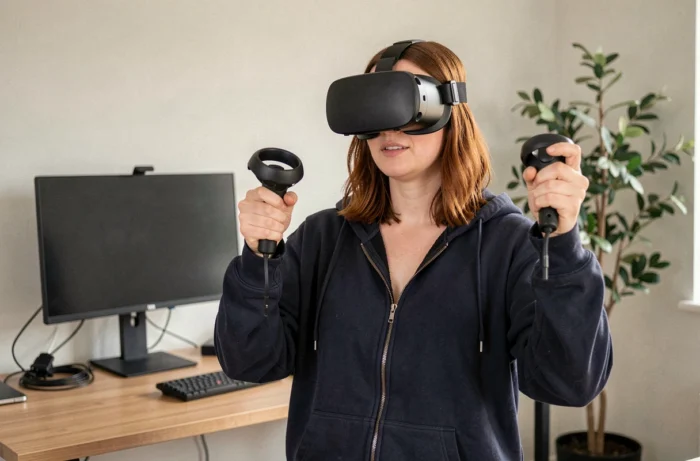
The Pico Space Pro features micro-OLED panels displaying a density of 4,000 pixels per inch. The angular resolution reaches about 40 pixels per degree, a threshold that significantly reduces the grid effect perceptible on previous generation headsets.
To put this level of resolution into perspective: the video passthrough becomes sharp enough to read text on a physical screen without removing the headset. Pico positions the Space Pro as a device capable of replacing traditional monitors in productivity use, not just as a gaming headset.
The micro-OLED technology also allows for a gain in compactness compared to traditional LCD screens. The panels being smaller at equivalent resolution, the optical system can be redesigned to reduce the front bulk of the headset. ByteDance has confirmed it is working on a lighter design, although the exact weight has not yet been disclosed.
Pico OS 6 and positioning against the Apple Vision Pro
The Pico OS 6 operating system accompanies this new hardware. The interface is oriented towards spatial reality, with an emphasis on productivity and the management of virtual windows in the user’s physical space. This software choice confirms that the Pico Space Pro is not solely targeting VR gamers.
In comparison to the Apple Vision Pro, the positioning plays out on several axes:
- The dual chip with an in-house perception coprocessor, whereas Apple also uses a dual-processor architecture (M2 + R1) to separate rendering and spatial tracking
- Micro-OLED panels of comparable density, aiming for sufficient sharpness for office work in mixed reality
- A different software ecosystem, backed by ByteDance and its application catalog, versus Apple’s integration with macOS and iOS
The major difference lies in the price. Even though Pico has not yet announced a final price, the premium positioning does not necessarily mean a price on par with the Apple Vision Pro. ByteDance has the capacity for hardware subsidies through its advertising revenues and digital platforms, a lever that Apple does not utilize.
Release date of the Pico Space Pro: postponed to Q4 2026
The official announcement was initially scheduled for September 3, 2026, in Beijing. Pico has postponed this event, pushing the launch to the fourth quarter of 2026. The reason given: additional software adjustments before market release.
This delay is not insignificant. Pico has simultaneously expanded its Early Access program (Pioneer Experience Program) by sending pre-production units to a broader panel of testers. This structured beta phase, with real hardware in circulation, allows for gathering field feedback before the commercial launch.
The postponement to Q4 2026 places the Pico Space Pro in a competitive window that is crowded. Samsung is preparing the European rollout of the Galaxy XR under Android XR, Valve is maintaining its ambitions with the Steam Frame, and Meta continues to iterate on its Quest lineup. The final timeline will also depend on the availability of micro-OLED components, a technology whose large-scale production remains an industrial challenge.
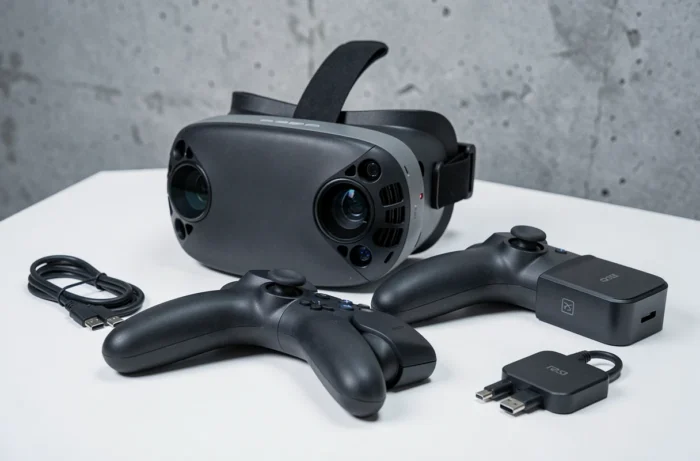
The transition from the name Pico 5 to Pico Space Pro signifies a deliberate break from the logic of incremental numbering. ByteDance is no longer seeking to sell a slightly better consumer VR headset than the previous one: the brand is building a high-end mixed reality device, with a proprietary hardware architecture and a rethought operating system. In the coming weeks, as Early Access testers share their feedback, it will clarify whether the technical ambition is confirmed in practice.