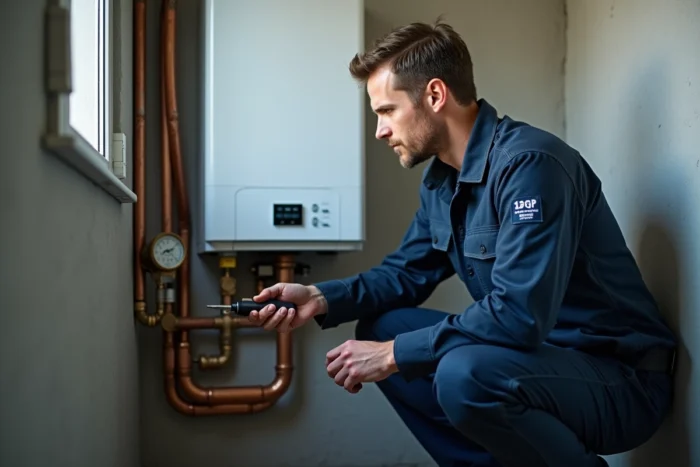
The F.28 code on a Saunier Duval boiler indicates an ignition failure after several attempts. The electronic board detects the absence of flame at the burner and locks the device for safety. We observe that this fault accounts for the majority of calls during the heating season, but its origins go far beyond just a lack of gas.
Condensate siphon and F.28 error: the cause that guides overlook
On Saunier Duval condensing boilers (ThemaPlus Condens, Isofast Condens, etc.), a blocked or frozen condensate siphon causes an F.28 lockout. The board puts the device in safety mode as soon as the drainage of condensate or flue gases is no longer ensured, even before the burner attempts a complete cycle.
In winter, the condensate pipe exposed to negative temperatures (uninsulated garage, passing through an exterior wall) often freezes. The acidic condensate stagnates, the pressure in the flue gas circuit rises, and the boiler interprets the situation as an ignition fault. We recommend systematically checking the siphon and the condensate lift pump before any other intervention when the F.28 appears in extreme cold.
To delve deeper into the causes of the F.28 error Saunier Duval, particularly those related to the evacuation of flue gases and condensates, a methodical diagnosis remains preferable to a simple repeated reset.
Ignition electrode and ionization probe: distinguishing two often confused faults
The ignition electrode generates the electric arc that ignites the air-gas mixture. The ionization probe, on the other hand, detects the actual presence of flame by measuring a micro-current. On most Saunier Duval models, these two functions are provided by a single combined electrode. The diagnosis is not simplified as a result.
Dirty or misaligned electrode
A carbon deposit on the tip of the electrode prevents the ignition arc. Cleaning with fine sandpaper (minimum grain 400) restores conductivity in most cases. We also observe that the gap between the electrode and the burner drifts after several thermal cycles: a few millimeters of misalignment are enough to prevent ignition.
Ionization fault without ignition problem
When the flame ignites briefly and then goes out, the problem lies in detection and not in ignition itself. The ionization current, normally a few microamperes, drops below the minimum threshold. Possible causes include:
- Broken or grounded ionization cable, which short-circuits the return signal to the board
- Unstable flame due to poor air/gas ratio, often related to a dirty fan or an improperly adjusted air damper
- Electronic board that no longer reads the ionization signal despite a functional electrode
Testing the ionization current with a multimeter set to microamperes, directly on the probe cable, allows you to distinguish between an electrode problem and a board problem.
Gas block and network pressure: checks before replacement
The gas block (or gas valve) regulates the fuel flow to the burner. A gas block stuck in the closed position logically triggers an F.28. We find that the replacement of the gas block is too often prescribed without prior verification of the dynamic pressure in the network.
An undersized gas meter or a faulty regulator upstream of the boiler reduces the supply pressure to the point of preventing the valve from fully opening. In propane installations, a tank nearing empty in cold weather produces the same effect: the vapor pressure drops, and the flow becomes insufficient.
The reliable procedure consists of measuring the dynamic pressure at the pressure take-off of the gas block during a flame demand. If the pressure complies with the manufacturer’s specifications but the block does not open, only then is replacement justified.

F.28 Saunier Duval reset: procedure and limitations
The reset is performed by pressing the reset button on the control panel. On models with a digital interface (Semia, ThemaPlus Condens), a long press of three seconds starts a new ignition cycle.
Never exceed two or three consecutive reset attempts. Each unsuccessful attempt sends unburned gas into the combustion chamber. Beyond that, the risk of micro-explosion upon reignition increases, and the electronic board may switch to hard lockout (code F.29 on some models), which requires physical intervention on the board.
A reset that works temporarily before the F.28 reappears a few hours later points to an intermittent fault. The usual suspects include:
- Ignition electrode whose deposit quickly reforms due to incomplete combustion
- Partially obstructed condensate siphon that clogs again after each heating cycle
- Gas pressure limit that fluctuates according to the demand from other devices connected to the same meter
- Fan whose bearing is wearing out and runs below the minimum speed required by the board
Annual maintenance and prevention of ignition faults
The mandatory maintenance of the gas boiler is not limited to checking CO emissions. Maintenance focused on preventing F.28 includes cleaning the electrode, checking the condensate siphon, testing the air pressure switch, and measuring the ionization current.
On Saunier Duval condensing boilers, cleaning the plate heat exchanger reduces deposits that disrupt the flame. A scaled exchanger alters the airflow in the chamber, destabilizes the flame, and causes the ionization signal to drop below the detection threshold.
Preventive replacement of the electrode every three to four years, depending on usage frequency, avoids the vast majority of F.28 errors related to wear. The cost of the part remains modest compared to an emergency intervention on a January Sunday.