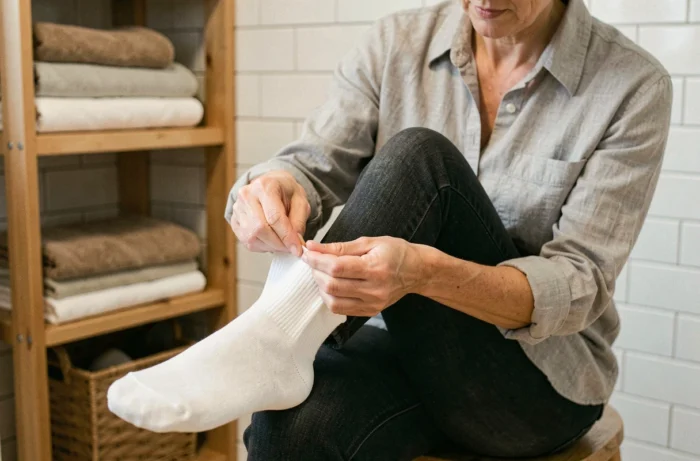
The elastic band of a compression sock or sports sock works like a textile spring: it exerts targeted tension on the top of the calf or the ankle. When this tension becomes excessive, the common reflex is to stretch the sock as a whole, which also loosens the foot’s mesh and destroys the support. Here we discuss methods that exclusively target the elastic band without compromising the fit of the rest of the sock.
Targeting the elastic band without loosening the foot’s mesh
The technical difficulty lies in the construction of the sock. The tightening band (at the top of the calf or below the knee) contains an elastomer thread, usually Lycra or synthetic rubber, knitted in tight ribs. The rest of the foot uses a looser mesh, sometimes in terry, which provides cushioning.
Stretching the entire sock relaxes the foot before the band, because the mesh of the foot offers less resistance than the reinforced area. The result: the sock slips in the shoe, the heel rises, and the compression benefit disappears.
To act solely on the band, we recommend physically isolating the tension area. Two approaches work well: inserting a calibrated cylindrical object or applying localized moist heat. Both rely on the same principle, the plastic deformation of the elastomer thread, but at different scales. If you’re looking to find out how to gradually relax the elastic of socks, the cylinder method remains the most controllable.
Calibrated cylinder method to relax the elastic of socks
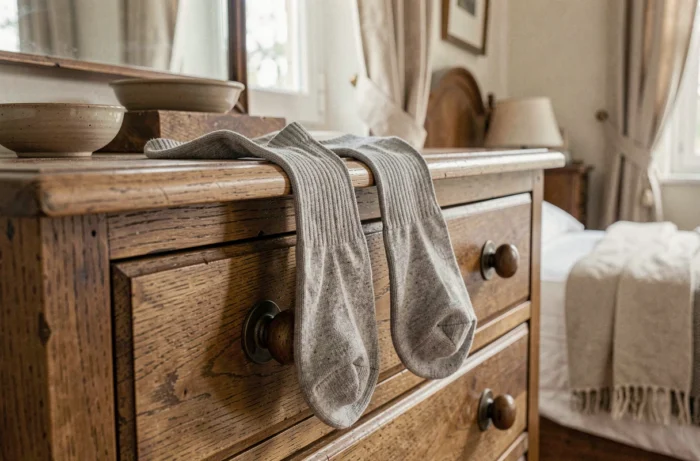
This technique exploits a slow and continuous deformation of the elastomer thread. It requires neither heat nor chemicals, making it compatible with all types of fibers, including merino wool and polyamide.
Choosing the support
The diameter of the cylinder determines the degree of stretching. A roll of paper towels (about 4-5 cm in diameter) is suitable for light relaxation. A plastic bottle with a narrow neck, inserted neck up, allows targeting the band without applying pressure on the foot of the sock.
- For minimal relaxation, use a cardboard tube from toilet paper, which exerts gentle and consistent pressure on the elastic band.
- For moderate relaxation, switch to a plastic bottle whose body is slightly wider than the natural circumference of the targeted calf.
- For more significant relaxation, slide the elastic band over a glass jar whose diameter exceeds that of the calf by a few centimeters.
The critical point: only the elastic band should be under tension on the cylinder. The foot of the sock hangs freely below, without being stretched. Leave the setup in place for twelve to twenty-four hours depending on the initial tightness.
Monitoring progress
We recommend proceeding in stages. Put on the sock after six hours, assess comfort, and then reapply if compression remains excessive. This approach avoids exceeding the threshold beyond which the band no longer keeps the sock in place.
Excessive relaxation is irreversible on a knitted elastomer. It’s better to do two cycles of twelve hours than one cycle of forty-eight hours.
Localized moist heat: steam and warm water on the band only
Heat temporarily softens the elastomer thread, allowing it to deform with less force. Steam is more effective than immersion, as it avoids wetting the foot’s mesh and causing felting on natural fibers.
Steam protocol
Turn the sock inside out, exposing the elastic band to steam from an iron or kettle for a few seconds. Immediately slide the sock onto the calibrated cylinder described above. The combination of heat + mechanical stretching produces a faster relaxation than cold stretching.
Be cautious with the temperature threshold. Lycra begins to permanently lose its elastic properties at high temperatures. Stay with moderate steam, avoiding direct contact between the sole of the iron and the fabric. Spandex and synthetic elastomers tolerate brief steam well but not prolonged dry heat.
Warm water variant
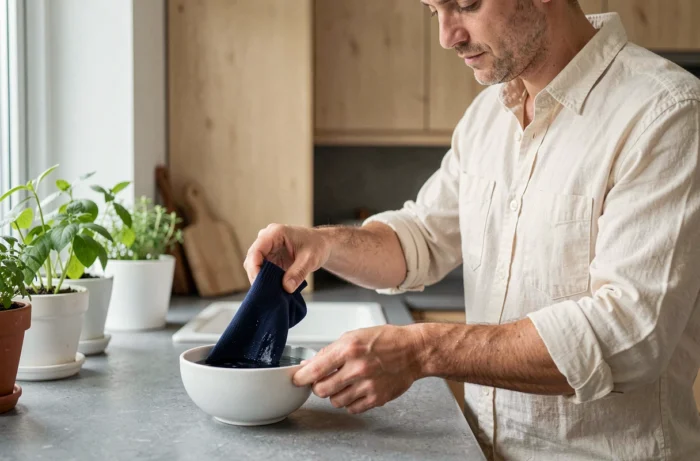
For cotton or synthetic fiber socks without wool, soak only the band (the first two or three centimeters) in warm water for a few minutes. Wring out without twisting, then slide onto the cylinder. Never immerse the entire sock if the goal is to only relax the band.
White vinegar, often mentioned for softening fibers, acts more on felted wool than on elastomer. Its usefulness is real for recovering a sock shrunk in washing, but marginal for relaxing a compression elastic band that has not changed in size.
Softening the elastic with controlled manual stretching
Manual stretching remains the quickest method, but also the riskiest for the integrity of the fabric. It is suitable for city socks made of cotton or polyester, less so for technical socks with graduated compression.
Pinch the elastic band between the two thumbs and two index fingers, spaced about five centimeters apart. Stretch laterally while maintaining tension for about ten seconds, then release. Repeat the gesture by shifting the grip all around the band.
- Work on dry socks to avoid weakening wet fibers.
- Never pull in the vertical direction (downwards), as this would deform the junction between the band and the body of the sock.
- Complete the entire band in four or five successive grips to distribute the stretching evenly.
Manual stretching only affects the first cycles: after three or four sessions, the elastomer has reached its maximum deformation without heat. If the band remains too tight after these attempts, switch to the steam + cylinder method.
A common pitfall is pulling the sock by the toe to “free” the foot. This action stretches the foot’s mesh without altering the tension of the band, producing exactly the opposite effect sought: a sock that gapes at the toes while compressing the calf.
The elastomer thread has a limited memory. Each manipulation moves it away from its original tension with no possibility of return. It’s better to proceed gradually, test comfort between each step, and accept that a sock whose band has been properly relaxed offers a different support than that of a new sock but remains functional if the foot has not been deformed.