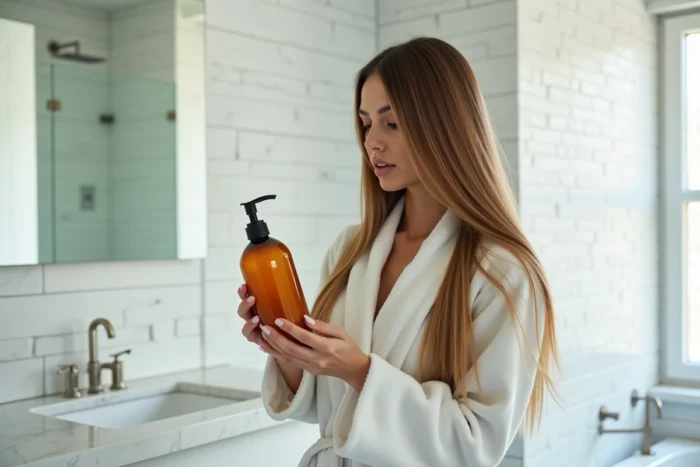
We leave the salon with smooth, shiny hair, thinking that the hardest part is done. In reality, the choice of shampoo in the weeks following a Brazilian straightening determines the longevity of the treatment. An ill-suited product can cut the duration of the smoothing effect in half, while a well-chosen formula prolongs the shine and flexibility of the hair fiber for several months.
The Brazilian straightening relies on the application of keratin, which fills in the gaps in the hair fiber, and is then sealed by the heat of a flat iron. This protective film remains vulnerable to aggressive cleansing agents. Understanding this mechanism changes the way we approach the shampoo aisle.
Why a sulfate shampoo strips the keratin from Brazilian straightening
Sodium laureth sulfate (SLS) and its derivatives produce abundant lather, but they act as powerful detergents on the layer of keratin deposited during the straightening. Specifically, each wash with a sulfate shampoo gradually strips away the treatment, bringing back frizz much sooner than expected.
We often see the same scenario in the salon: a client returns three weeks after her straightening complaining that “it hasn’t lasted.” Upon digging deeper, we discover that she is using her old shampoo, often rich in sulfates and salt. Field reports confirm that a sulfate shampoo significantly shortens the longevity of the straightening.
Salt (sodium chloride), present in many conventional formulas, poses the same problem. It lifts the hair cuticles, exactly the opposite of what Brazilian straightening aims to achieve. When looking to know which shampoo to use after Brazilian straightening, Beauté Chic details the formulations to prioritize, particularly sulfate-free and salt-free products with a gentle pH.
Concrete criteria for choosing a shampoo after Brazilian straightening
Beyond the absence of sulfates, several criteria distinguish a good post-straightening shampoo from a product that is simply “gentle.”
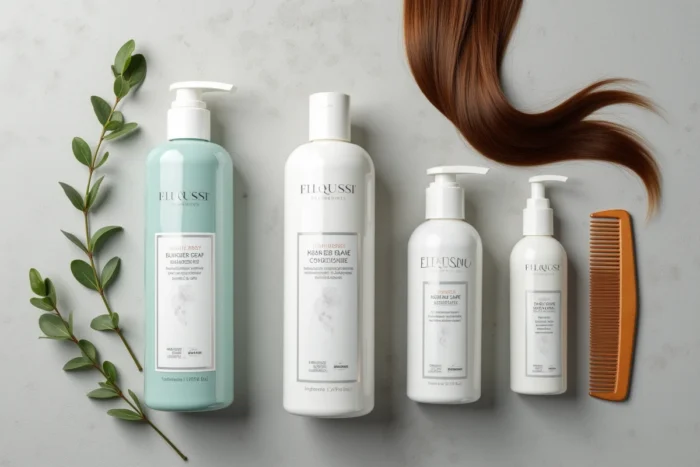
- pH between 4.5 and 6: a pH that is too alkaline opens the cuticles of the hair fiber and allows keratin to escape. Shampoos with a slightly acidic pH keep the cuticles closed and preserve shine.
- Presence of amino acids or hydrolyzed keratin in the INCI list: these active ingredients reinforce the treatment applied in the salon by filling in micro-gaps between appointments.
- Absence of parabens and heavy silicones (non-soluble dimethicone): non-soluble silicones create a film that prevents keratin from properly adhering during any potential salon maintenance.
- Formula without salt (sodium chloride): as we have seen, salt is a direct enemy of the smoothing layer.
Checking these four points on the label takes a minute. It’s a reflex that makes the difference between a straightening that lasts and one that fades in a few weeks.
Washing frequency and habits that protect the hair fiber
The product matters, but the way we wash our hair after Brazilian straightening is equally important. Spacing out washes is the first field recommendation: two to three washes per week are sufficient for most treated hair types. Each contact with water and shampoo, even gentle ones, stresses the keratin layer.
The temperature of the water also plays a direct role. Very hot water opens the cuticles, while rinsing with lukewarm or cool water closes them. This simple gesture prolongs the smooth and silky appearance of the hair between treatments.
Hard water, an underestimated factor
In many regions, tap water is high in calcium. These mineral deposits dull the hair and can interfere with keratin. A final rinse with filtered or mineral water after shampooing limits this problem. Feedback varies on this point depending on the hardness of the local water, but in very hard water areas, the difference is noticeable.
Post-straightening shampoo in summer: chlorine, sea salt, and humidity
Summer brings all the enemies of Brazilian straightening. Chlorine from pools attacks keratin, salt-laden seawater lifts the cuticles, and ambient humidity causes the hair fiber to swell.
Before any swimming, one can apply a leave-in treatment or a light oil that creates a barrier between the hair and the aggressive water. After swimming, immediately rinse the hair with clear water to limit the absorption of chlorine and salt. The gentle shampoo will follow, without excessively rubbing the scalp.
During periods of high humidity, a shampoo containing anti-frizz agents (silk proteins, light coconut oil) helps maintain the smoothing effect. The goal is not to weigh down the hair but to keep the cuticles closed despite the humidity.
Adapting your hair care routine to the season
In winter, indoor heating dries out the fiber. One can alternate with a slightly more nourishing shampoo, still sulfate-free. In summer, a lighter formula with UV protection, if available, is preferred. This seasonal alternation avoids overloading the hair while protecting it according to real constraints.
Combining shampoo and complementary treatments for lasting results
The shampoo alone does not do everything. A conditioner or keratin mask applied once a week strengthens the structure of the treated hair. The mask is applied to the lengths and ends, never on the roots, to avoid weighing down the hair.
A keratin-based serum as a finishing touch protects the ends, which are the most exposed to friction and breakage. A few drops on damp hair before drying are sufficient.
The choice of shampoo after Brazilian straightening is not trivial: it is the first link in a routine that determines the longevity of the treatment. Without sulfates, without salt, with a gentle pH, combined with spaced washes and careful rinsing, the right product transforms a straightening that “lasts three weeks” into a result that accompanies the hair for several months.